Our recommendations
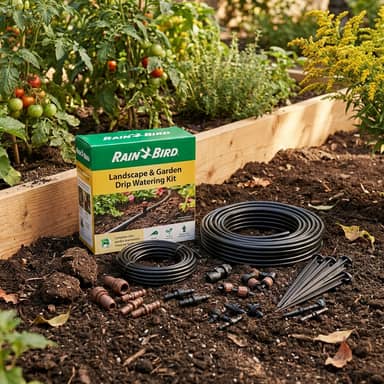
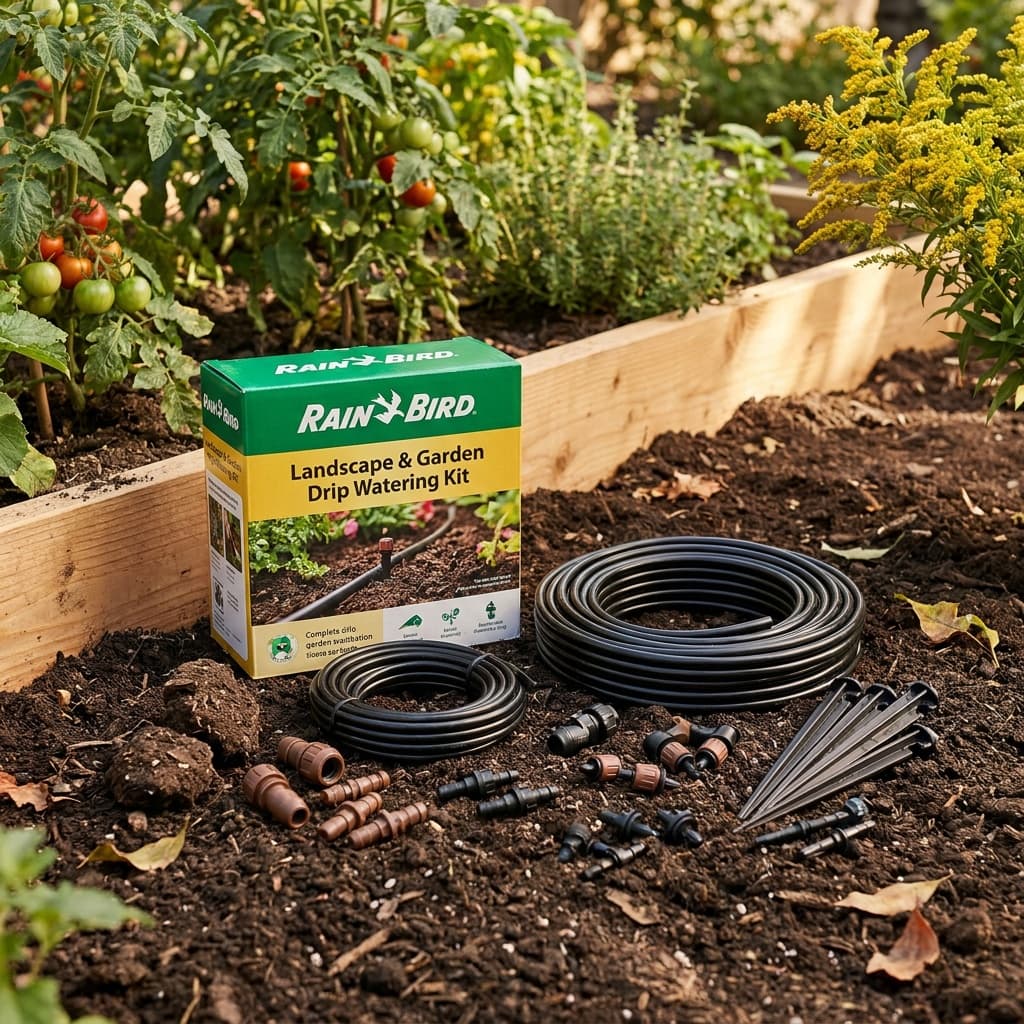
Rain Bird Drip Irrigation Landscape and Garden Watering Kit
Why this pick →
Raindrip Automatic Watering Kit with Timer (R560DP)
Why this pick →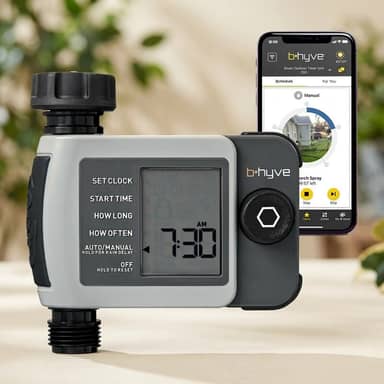
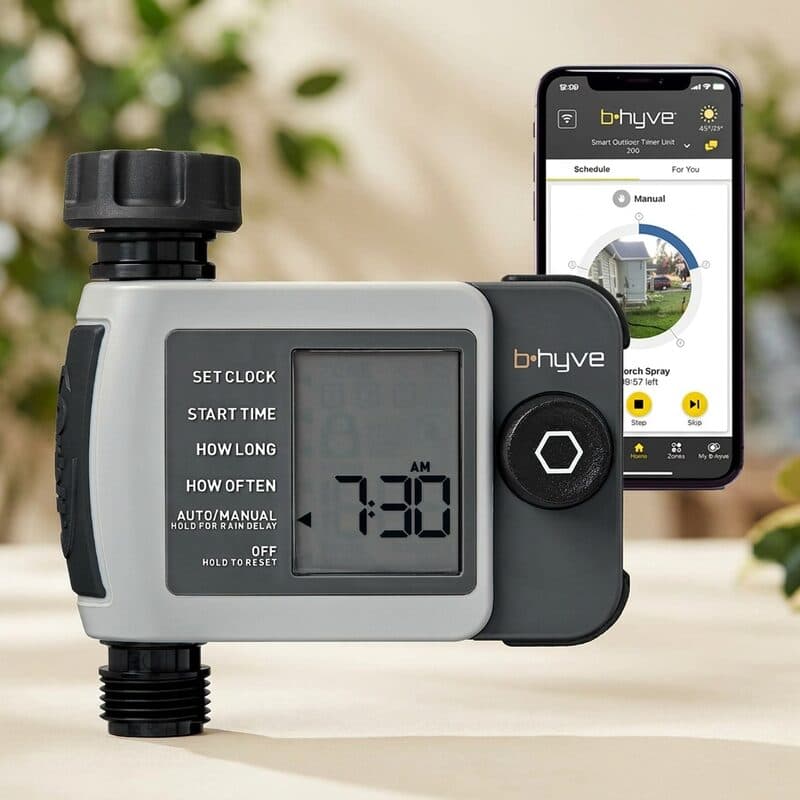
Orbit B-hyve Smart Hose Faucet Timer
Why this pick →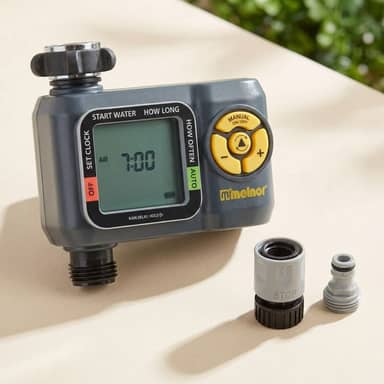
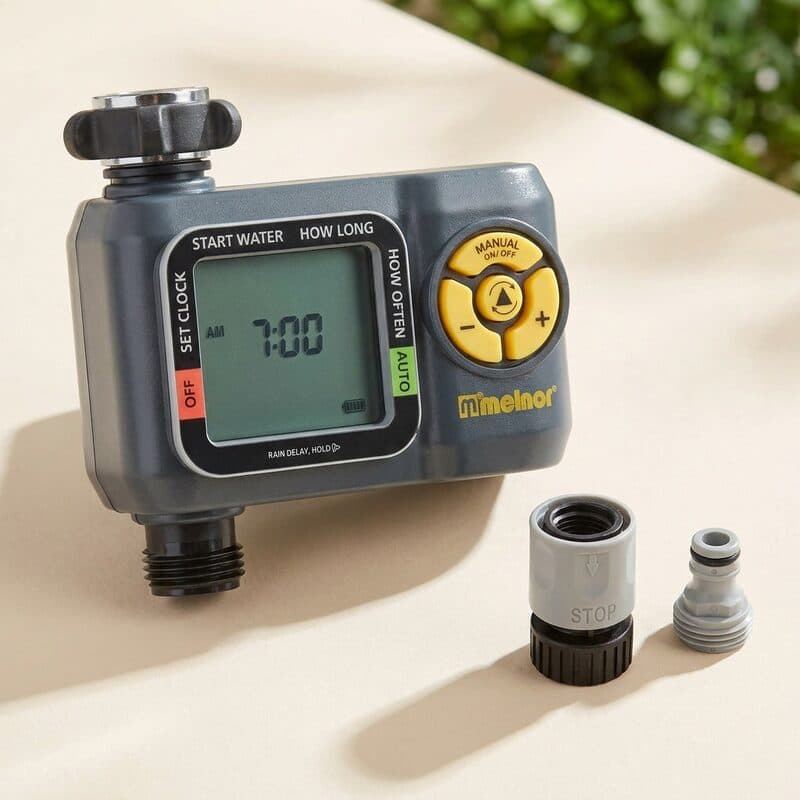
Melnor Digital Water Timer
Why this pick →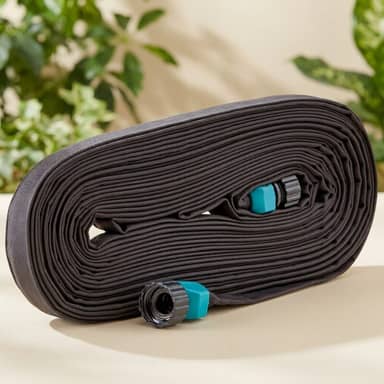
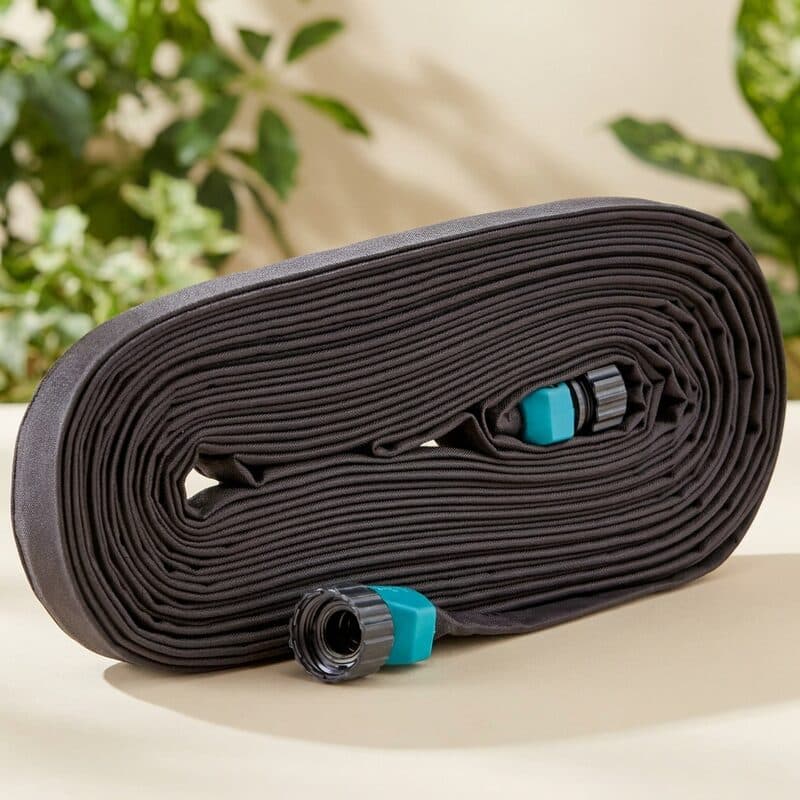
Gilmour Flat Weeper Soaker Hose
Why this pick →Hand-watering works until the day you go away for a weekend in July. Automatic watering is the upgrade that saves more plants than any other piece of gear, and it cuts water waste while it does it. The decision splits two ways: what delivers the water (a drip kit with emitters, or a soaker hose) and what controls it (a smart timer, a dial timer, or nothing). This guide covers both halves so you can build a system that fits your beds.
Drip vs soaker hose: how to pick
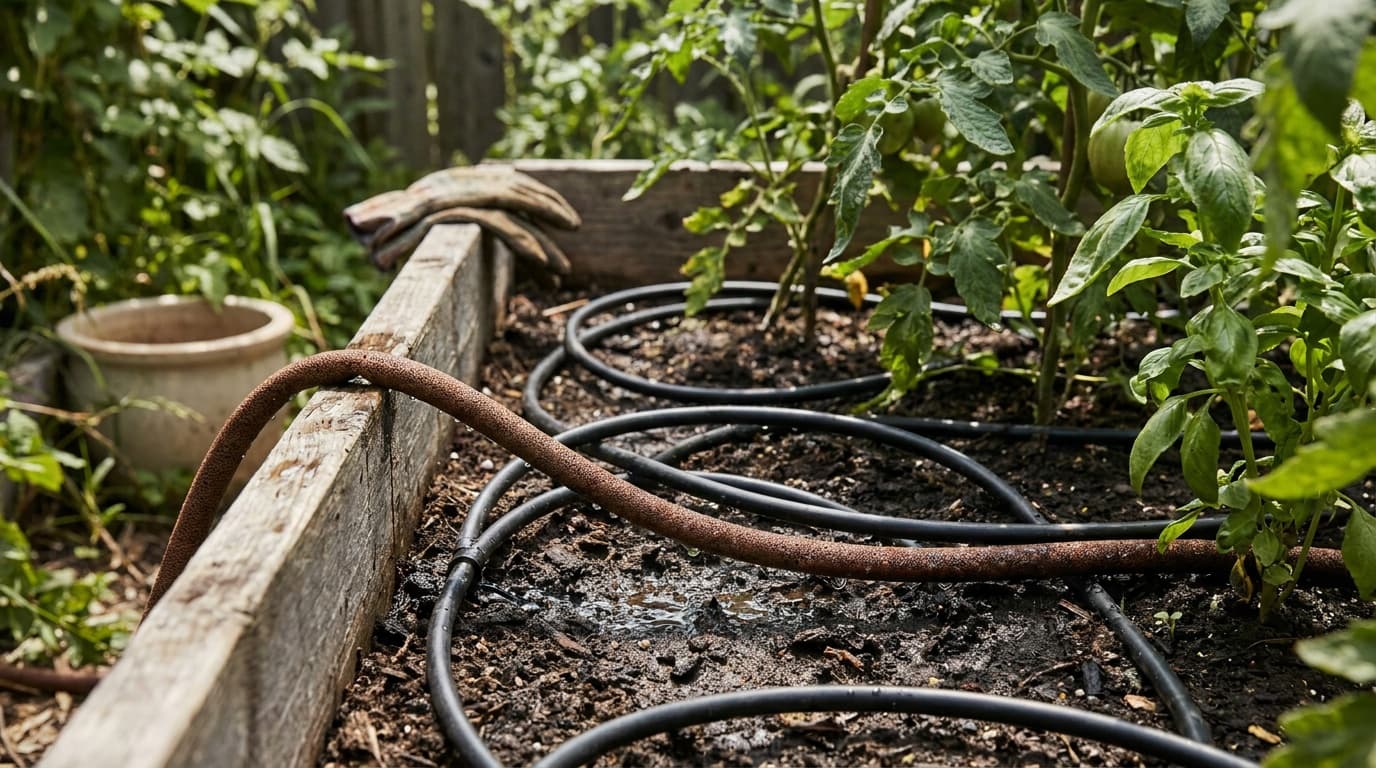
A drip kit runs water through tubing to individual emitters that drip at a set rate exactly where you place them. That precision is the strength: you put water at the base of each plant, waste almost none to evaporation, and you can dial different flow rates for thirsty tomatoes versus a row of herbs. Drip is the better choice for mixed beds, containers, and anything you want to water precisely.
A soaker hose is simpler. It weeps water along its entire length, so you snake it down a row and the whole line gets a slow, even soak. There are no emitters to plan or clog. Soakers are ideal for densely planted rows, borders, and new seedbeds where you want broad, gentle coverage and minimal setup.
Best overall kit: Rain Bird
Best overall
Rain Bird Drip Irrigation Landscape and Garden Watering Kit
Best for: Gardeners building an expandable drip system across rows and landscape beds.
Keep in mind: No timer included; automation requires a separate purchase
Amazon price as of the checked date, subject to change. The price on Amazon at checkout applies.
Full research
- Type
- Landscape and garden drip kit
- Tubing
- 1/4 in distribution tubing
- Emitters
- Adjustable and fixed-rate emitters
- Connection
- Standard hose faucet
Rain Bird's drip kit provides quality tubing and emitters from a trusted irrigation brand, designed to expand across rows and landscape beds.
This catalog-wide research score is separate from this guide's use-case ranking. How we research
Strengths
- Modular system expands as the garden grows
- Fittings and emitters from a long-established irrigation brand
- Covers rows and beds, not just containers
Weaknesses
- No timer included; automation requires a separate purchase
- Layout planning takes more effort than a container kit
Sprout Score breakdown
Best for
Gardeners building an expandable drip system across rows and landscape beds.
Owner rating snapshot
Amazon · 925 reviews · 4.5 stars
The Rain Bird kit is our top pick because it balances trusted-brand components, a sensible starter set, and real expandability. It includes 1/4 inch distribution tubing plus a mix of adjustable and fixed-rate emitters, connects to a standard hose faucet, and grows as your garden does: you add more Rain Bird tubing and emitters rather than buying a whole new system. That upgrade path is what separates a kit you outgrow in one season from one you build on for years.
It does not include a timer, so pair it with one of the timers below to make it fully automatic. Plan your emitter layout against your bed sizing before you cut tubing.
Best kit with timer: Raindrip Automatic Watering Kit

Best with timer
Raindrip Automatic Watering Kit with Timer (R560DP)
Best for: Container and patio gardeners who want automatic watering with minimal setup.
Keep in mind: Plastic fittings are less rugged than premium components
Amazon price as of the checked date, subject to change. The price on Amazon at checkout applies.
Full research
- Type
- Container and patio drip kit
- Timer
- Battery-powered automatic timer included
- Tubing
- 1/4 in and 1/2 in poly tubing
- Connection
- Standard hose faucet
Raindrip's automatic kit bundles a faucet timer, tubing, and emitters into a beginner-friendly drip system for containers and small plantings.
This catalog-wide research score is separate from this guide's use-case ranking. How we research
Strengths
- Includes a timer, so it automates watering out of the box
- Beginner-friendly assembly with no special tools
- Inexpensive way to test drip irrigation
Weaknesses
- Plastic fittings are less rugged than premium components
- Coverage suits containers and small areas, not large beds
Sprout Score breakdown
Best for
Container and patio gardeners who want automatic watering with minimal setup.
If you want one box that does everything, the Raindrip kit bundles a battery-powered timer with 1/4 inch and 1/2 inch poly tubing and emitters at a low all-in price. It is aimed squarely at containers, hanging baskets, and small beds, which makes it the easiest path for patio and balcony gardeners who do not want to source a timer separately. It is less suited to large in-ground systems than the expandable Rain Bird, but for a compact, self-contained setup it is the simplest win.
Best smart timer: Orbit B-hyve
Companion Smart timer
Orbit B-hyve Smart Hose Faucet Timer
Best for: Gardeners who want app control and weather-aware automatic watering.
Keep in mind: WiFi setup can be finicky at the faucet's signal range
Amazon price as of the checked date, subject to change. The price on Amazon at checkout applies.
Full research
- Connectivity
- WiFi and Bluetooth
- Scheduling
- App-based, weather-adjusting
- Zones
- Single outlet (multi-outlet models available)
- Power
- Battery powered
Orbit's B-hyve smart timer adds WiFi and Bluetooth control with weather-based scheduling, automating faucet watering from a phone app.
This catalog-wide research score is separate from this guide's use-case ranking. How we research
Strengths
- Weather-based scheduling skips watering after rain
- Controllable from a phone over WiFi or Bluetooth
- Flexible programs for multiple watering windows
Weaknesses
- WiFi setup can be finicky at the faucet's signal range
- Costs more than a basic mechanical dial timer
Sprout Score breakdown
Best for
Gardeners who want app control and weather-aware automatic watering.
Owner rating snapshot
Amazon · 17 reviews · 4.1 stars
The Orbit B-hyve adds useful intelligence to a faucet timer. It connects over WiFi and Bluetooth, schedules from a phone app, and adjusts watering based on local weather, so it skips a cycle after rain instead of dumping water on an already-soaked bed. For gardeners who travel, manage multiple beds, or simply want watering handled without thinking about it, the weather-aware automation earns its modest premium over a dial timer. The base unit is a single outlet, with multi-outlet models available if you need to run more than one zone.
Best value timer: Melnor Digital Water Timer
Companion Value timer
Melnor Digital Water Timer
Best for: Gardeners who want set-and-forget automatic watering without smart-app complexity.
Keep in mind: No smart or weather-based features
Amazon price as of the checked date, subject to change. The price on Amazon at checkout applies.
Full research
- Type
- Digital programmable timer
- Scheduling
- Set frequency and duration
- Override
- Manual on/off button
- Power
- Battery powered
Melnor's digital water timer offers straightforward programmable scheduling with a manual override, automating a single faucet without an app.
This catalog-wide research score is separate from this guide's use-case ranking. How we research
Strengths
- Straightforward digital programming without an app
- Manual override for off-schedule watering
- Affordable automation for a single faucet
Weaknesses
- No smart or weather-based features
- Small display can be hard to read in bright sun
Sprout Score breakdown
Best for
Gardeners who want set-and-forget automatic watering without smart-app complexity.
Owner rating snapshot
Amazon · 18 reviews · 4.1 stars
Not everyone wants an app. The Melnor digital timer gives you straightforward programmable scheduling, set the frequency and duration, plus a manual on/off override button, at a lower cost than a connected smart timer. It is the set-and-forget choice for a gardener who wants reliable automatic watering without WiFi setup or phone notifications. You lose the weather-skip feature, so you will adjust the schedule by hand through the season, but for most single-zone gardens that is a fair trade.
Best soaker: Gilmour Flat Weeper
Alternative Soaker hose
Gilmour Flat Weeper Soaker Hose
Best for: Row and border gardeners who want low-waste, root-zone watering on a budget.
Keep in mind: Even output drops over very long runs and on slopes
Amazon price as of the checked date, subject to change. The price on Amazon at checkout applies.
Full research
- Type
- Flat weeper soaker hose
- Lengths
- Available in multiple lengths
- Delivery
- Seeps along the full length
- Connection
- Standard hose faucet
Gilmour's flat weeper soaker hose seeps water along its length to deliver moisture at the root zone, lying flat along rows and borders.
This catalog-wide research score is separate from this guide's use-case ranking. How we research
Strengths
- Delivers water directly to the root zone with little waste
- Flat profile lies neatly along rows and borders
- Inexpensive and easy to route through a bed
Weaknesses
- Even output drops over very long runs and on slopes
- Should be drained and stored to avoid winter damage
Sprout Score breakdown
Best for
Row and border gardeners who want low-waste, root-zone watering on a budget.
Owner rating snapshot
Amazon · 49 reviews · 4.2 stars
For broad root-zone watering on a budget, the Gilmour flat weeper soaker hose is the simple answer. Its flat profile lies close to the soil and seeps along its full length, delivering a slow soak right at the roots with very little waste to evaporation or runoff. It comes in multiple lengths and connects to a standard faucet, so you can run it down a row of beans or along a border and let it do the work. Pair it with a timer for hands-off operation.
How to choose a watering system
Emitters and zones. Drip emitters come in fixed rates (often 0.5, 1, or 2 gallons per hour) and adjustable types. Group plants with similar water needs onto the same line so one run time suits all of them. A "zone" is just a section of your system on one valve or timer; keep total emitter flow within what your faucet pressure can supply.
Bed sizing. Measure your beds before buying. Long single-crop rows favor soaker hoses or evenly spaced inline drip. Wide mixed beds and container clusters favor a drip kit with individually placed emitters. The planting calendar can help you map out what is going where and when, which makes laying out water lines much easier.
Smart vs dial timers. A smart timer (like the B-hyve) skips watering after rain and runs from your phone. A dial or digital timer (like the Melnor) is cheaper and reliable but needs manual seasonal adjustment. Choose smart if you travel or run several beds; choose dial if you want simplicity.
Pressure and filtration. Most home drip runs on standard faucet pressure, and a pressure regulator plus a small filter (often included or cheap to add) keeps emitters from clogging and blowing out. Do not skip them.
| Product | Price | Best for | Buy |
|---|---|---|---|
| Rain Bird Drip Irrigation Landscape and Garden Watering Kit#1 · BEST OVERALL | Typical price range · $25-$50 | Gardeners building an expandable drip system across rows and landscape beds. | Shop Amazon |
| Raindrip Automatic Watering Kit with Timer (R560DP)#2 · BEST WITH TIMER | Typical price range · $25-$50 | Container and patio gardeners who want automatic watering with minimal setup. | Shop Amazon |
| Orbit B-hyve Smart Hose Faucet TimerCompanion · SMART TIMER | Typical price range · $50-$100 | Gardeners who want app control and weather-aware automatic watering. | Shop Amazon |
| Melnor Digital Water TimerCompanion · VALUE TIMER | Typical price range · $25-$50 | Gardeners who want set-and-forget automatic watering without smart-app complexity. | Shop Amazon |
| Gilmour Flat Weeper Soaker HoseAlternative · SOAKER HOSE | Typical price range · Under $25 | Row and border gardeners who want low-waste, root-zone watering on a budget. | Shop Amazon |
Is drip irrigation better than a soaker hose?
They suit different layouts. Drip places water precisely at each plant through emitters, which is ideal for mixed beds and containers and wastes the least water. A soaker hose weeps along its whole length for an even soak, which is simpler and better for solid rows and borders. Drip offers more control; soakers offer less setup.
Do I need a pressure regulator for a drip system?
In most home gardens, yes. Standard faucet pressure is often higher than drip emitters are rated for, which can cause them to pop off or fail over time. A pressure regulator (and a small inline filter to stop clogs) keeps the system running reliably. Many kits include one or make it an inexpensive add-on.
Can I leave a drip irrigation system out over winter?
In freezing climates, drain and store the timer and any above-ground components before the first hard freeze, since trapped water expands and cracks fittings. Tubing left in the ground usually survives, but timers and backflow parts should come indoors. Check our planting calendar for your region's first-frost timing.
How long should I run drip irrigation?
It depends on emitter flow rate, soil, and weather, but a common starting point is 30 to 60 minutes a few times a week, then adjust based on how moist the soil is a few inches down. Deep, less frequent watering builds deeper roots than short daily cycles. Dig in and check rather than guessing.
Does a smart hose timer really save water?
A weather-aware smart timer like the B-hyve can, because it skips or shortens cycles after rain instead of running a fixed schedule onto already-wet soil. The savings depend on your climate and how much it rains during your season, but avoiding redundant watering both conserves water and protects plants from overwatering.
Choose drip lines or soaker hoses for each bed, then add a timer that matches how often you want to adjust the schedule. Use our planting calendar to line up the watering setup with each planting window.