Our recommendations
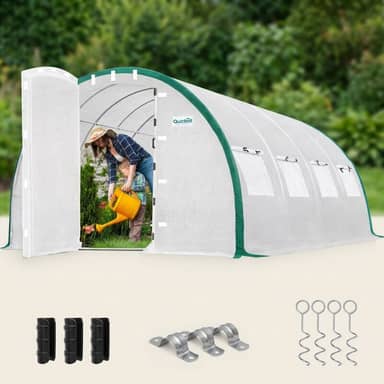
Quictent 20 x 10 ft Walk-In Greenhouse (Reinforced)
Why this pick →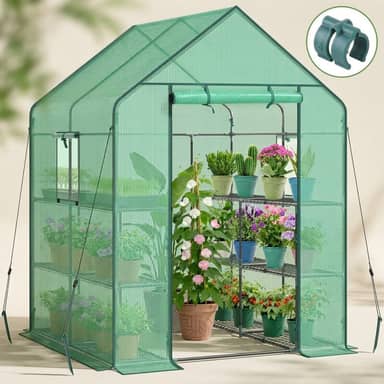
Ohuhu Walk-In Greenhouse, 3 Tiers / 12 Shelves (58 x 30 in)
Why this pick →
Gardman 4-Tier Mini Growhouse (27 x 18 x 63 in)
Why this pick →A portable walk-in greenhouse is a steel or resin frame wrapped in a clear polyethylene (PE) cover. It traps solar heat to give you a warm, sheltered space for starting seeds weeks early, hardening off trays in bulk, and protecting tender plants through cold snaps, without the cost, permits, or permanence of a glass structure. The category runs from full standing rooms to a shelf rack with a zip cover, so the right pick depends on how much you grow and how much yard you have.
Two things separate a greenhouse that lasts from one that shreds in the first storm: cover quality and anchoring. We weighted both heavily below. Whatever you choose, the payoff is timing, so run your ZIP through the planting calendar and check your frost dates to plan how many weeks of early starts and late protection the structure buys you.
Best overall: Quictent large walk-in greenhouse
Best overall
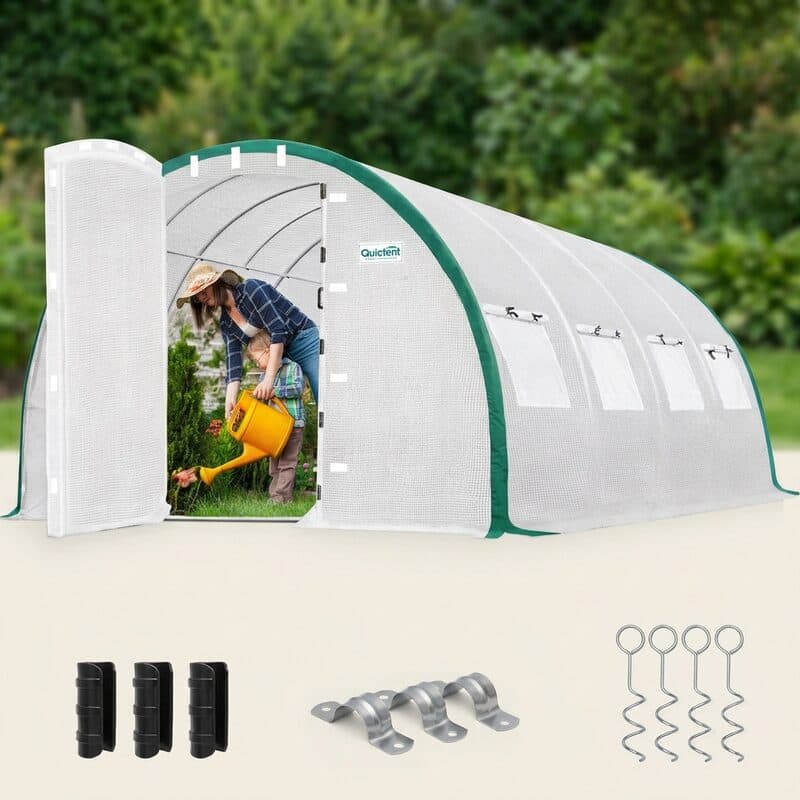
Quictent 20 x 10 ft Walk-In Greenhouse (Reinforced)
Best for: Gardeners who want a large, affordable walk-in structure to extend the season for trays, pots, and tall plants.
Keep in mind: Large canopy catches wind and must be firmly anchored to stay put in gusts
Amazon price as of the checked date, subject to change. The price on Amazon at checkout applies.
Full research
- Footprint
- 20 ft L x 10 ft W x 6.6 ft H
- Frame
- 0.7mm thickened galvanized steel
- Cover
- Reinforced PE with windows
- Doors
- 2 zippered doors
Quictent's reinforced 20 x 10 foot walk-in greenhouse pairs a thickened galvanized steel frame with a windowed PE cover and two doors, creating an affordable warm room to extend the season.
This catalog-wide research score is separate from this guide's use-case ranking. How we research
Strengths
- 20 x 10 foot walk-in room fits trays, pots, and tall plants with space to move
- Upgraded 0.7mm galvanized steel frame resists rust better than thin-tube tunnels
- Two doors and screened windows give real cross-ventilation on warm days
Weaknesses
- Large canopy catches wind and must be firmly anchored to stay put in gusts
- Soft PE cover is a multi-season consumable, not a rigid-panel lifetime structure
Sprout Score breakdown
Best for
Gardeners who want a large, affordable walk-in structure to extend the season for trays, pots, and tall plants.
Owner rating snapshot
Amazon · 87 reviews · 4.4 stars
The Quictent earns the top slot because it gets the fundamentals right at a size you can work in. The powder-coated steel frame is sturdier than the thin tubing on many portable units, the cover is a reinforced PE that resists tearing better than basic film, and there is real venting: a zippered door plus screened windows that let you dump heat on a sunny day, which is the single most important feature for keeping plants alive inside a greenhouse.
It also ships with anchoring hardware, ground stakes and ropes, and that matters more than almost anything else with a portable greenhouse. A lightweight structure with a big cover is essentially a sail; the difference between a greenhouse that survives a storm and one that ends up in a neighbor's yard is whether it was staked and tied down properly. For a gardener who wants a standing space to start seeds and overwinter potted plants, this is the balanced choice.
Best mid-size: Ohuhu 3-tier walk-in greenhouse
Best mid-size
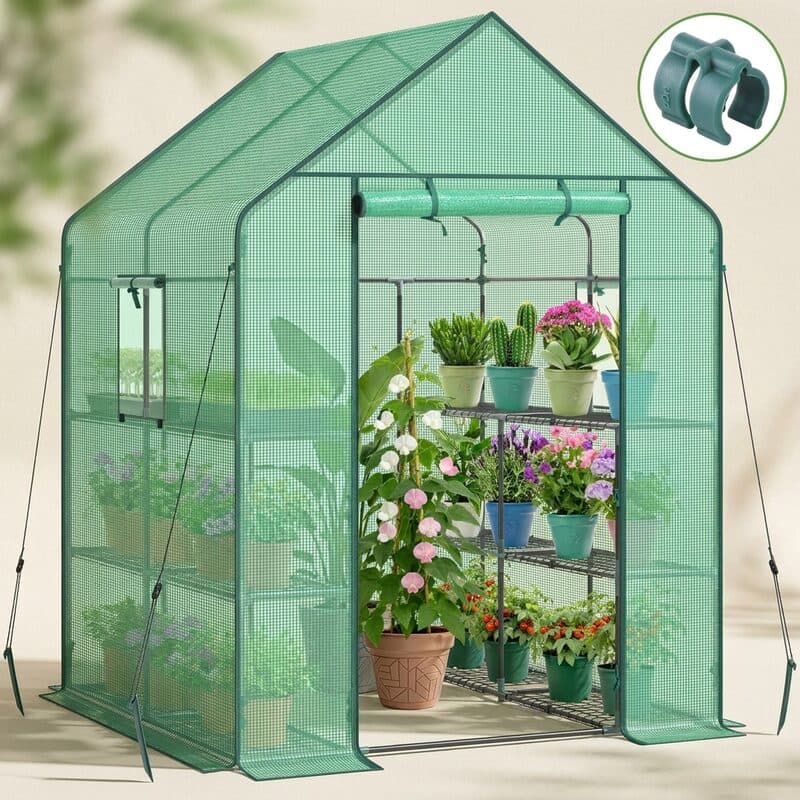
Ohuhu Walk-In Greenhouse, 3 Tiers / 12 Shelves (58 x 30 in)
Best for: Patio and balcony gardeners who want a compact walk-in greenhouse with lots of shelf space for seed-starting and hardening off.
Keep in mind: Tall, light frame must be staked and tied or it tips and lifts in wind
Amazon price as of the checked date, subject to change. The price on Amazon at checkout applies.
Full research
- Footprint
- 57.9 in L x 30.3 in W x 76.8 in H
- Shelving
- 3 tiers, 12 wired shelves
- Frame
- Powder-coated steel tubing
- Cover
- Heavy-duty PE with mesh windows
Ohuhu's walk-in greenhouse stacks twelve wired shelves across three tiers under a windowed PE cover, giving compact patios a tool-free, affordable structure for seed-starting and hardening off.
This catalog-wide research score is separate from this guide's use-case ranking. How we research
Strengths
- Twelve shelves across three tiers pack a lot of trays into a small footprint
- No-tools assembly goes together in minutes for one person
- Screened side windows give airflow and keep pests off the seedlings
Weaknesses
- Tall, light frame must be staked and tied or it tips and lifts in wind
- PE cover is a seasonal consumable that degrades after a few years of UV exposure
Sprout Score breakdown
Best for
Patio and balcony gardeners who want a compact walk-in greenhouse with lots of shelf space for seed-starting and hardening off.
Owner rating snapshot
Amazon · 77 reviews · 4.3 stars
The Ohuhu splits the difference between a full room and a shelf rack. You can step inside, but the real draw is the integrated three-tier shelving on each side, which turns the footprint into a lot of usable tray space for seed starting and hardening off. For a gardener who is mostly raising flats of seedlings rather than tall potted plants, that vertical layout uses the space efficiently.
The cover is a clear PE with a roll-up zippered door, and ventilation is adequate for spring and fall use as long as you open it on warm days. The trade-off against the Quictent is overall robustness and headroom: it is a lighter structure, so anchoring is just as critical and the shelving limits how tall a plant you can grow. As a dedicated seed-starting and hardening-off station, it is a strong, organized option.
Best value compact: Gardman 4-tier mini growhouse

Alternative Compact growhouse
Gardman 4-Tier Mini Growhouse (27 x 18 x 63 in)
Best for: Budget and small-space gardeners who want four shelves of protected seed-starting space against a wall or railing.
Keep in mind: Thin PE cover and clip-on shelves are not built for heavy pots or wind
Amazon price as of the checked date, subject to change. The price on Amazon at checkout applies.
Full research
- Footprint
- 27 in L x 18 in W x 63 in H
- Shelves
- 4 tiers
- Frame
- Steel tube
- Cover
- Polyethylene, zippered roll-up front
Gardman's 4-tier mini growhouse stacks four shelves under a zippered PE cover in a 27 x 18 inch footprint, the lowest-cost way to add protected seed-starting space on a patio or against a wall.
This catalog-wide research score is separate from this guide's use-case ranking. How we research
Strengths
- Four shelves in a tiny footprint fit on a balcony, patio, or against a wall
- Among the cheapest ways to add heated growing space for seed-starting
- Zippered roll-up front opens fully for venting and watering access
Weaknesses
- Thin PE cover and clip-on shelves are not built for heavy pots or wind
- Must be anchored to a wall or railing or it topples easily when loaded
Sprout Score breakdown
Best for
Budget and small-space gardeners who want four shelves of protected seed-starting space against a wall or railing.
The Gardman is not a room you walk into; it is a four-shelf steel rack with a clear roll-up PE cover, and that is exactly its appeal. It costs a fraction of a full walk-in, assembles in minutes, and tucks against a sunny wall, balcony, or patio corner where a larger structure would never fit. For starting seeds, hardening off a modest number of trays, and protecting a few potted plants, it does the job at the lowest entry price in this list.
The cover and zipper are the lightest-duty in this roundup, so store the greenhouse between seasons. Its light, tall frame can also tip or blow over unless you tie it to a wall bracket or rail. Within those limits, it is the least expensive way to add a controlled growing space.
If what you actually need is shade and bug protection for an outdoor work area rather than trapped heat, a screen house is the better buy; see the guide to the best screen houses on Kit Authority.
How to choose a walk-in greenhouse
Five specs decide whether a portable greenhouse works for you.
Size and headroom. Match it to what you grow. A full walk-in suits tall potted plants and a standing workspace; a tiered unit maximizes tray capacity for seed starting; a mini growhouse handles a handful of shelves. Buy the size your plants and your yard actually call for, since a bigger cover also catches more wind.
Cover material. Reinforced or UV-treated PE lasts longer and resists tearing better than thin film. The cover is the first thing to fail, so its quality, and the strength of the seams and zippers, largely determines the greenhouse's lifespan.
Frame. Powder-coated steel is stronger and more rust-resistant than bare tubing or resin connectors. Check the joints, since connector failures are a common collapse point.
Venting. Look for a zippered door plus at least one screened window or roll-up panel. Without enough venting, the interior overheats on sunny days, which kills more greenhouse plants than cold ever does.
Anchoring. This is non-negotiable for any portable greenhouse. Prefer models that ship with stakes and guy ropes, and plan to add ground anchors or weights regardless. Wind is the leading cause of failure.
| Product | Price | Best for | Buy |
|---|---|---|---|
| Quictent 20 x 10 ft Walk-In Greenhouse (Reinforced)#1 · BEST OVERALL | Typical price range · $170–$230 | Gardeners who want a large, affordable walk-in structure to extend the season for trays, pots, and tall plants. | Shop Amazon |
| Ohuhu Walk-In Greenhouse, 3 Tiers / 12 Shelves (58 x 30 in)#2 · BEST MID-SIZE | Typical price range · $60–$100 | Patio and balcony gardeners who want a compact walk-in greenhouse with lots of shelf space for seed-starting and hardening off. | Shop Amazon |
| Gardman 4-Tier Mini Growhouse (27 x 18 x 63 in)Alternative · COMPACT GROWHOUSE | Typical price range · $25–$45 | Budget and small-space gardeners who want four shelves of protected seed-starting space against a wall or railing. | Shop Amazon |
Frequently asked questions
How do I keep a portable greenhouse from blowing away?
Anchor it on every front. Stake all corners into the ground, run the included guy ropes to ground anchors, and where possible tie the frame to a fence, wall bracket, or rail. Adding weight inside the base (pavers or filled containers) helps too. A lightweight greenhouse with a large cover acts like a sail, so wind, not material quality, causes most failures.
How much earlier can I start seeds in a walk-in greenhouse?
A walk-in greenhouse typically lets you start seeds several weeks before your last frost and extend the harvest a few weeks past the first fall frost, depending on your climate and how cold it gets at night. The structure traps daytime solar heat but offers limited overnight protection on its own, so pair it with your frost dates to plan realistically.
Do walk-in greenhouses need ventilation?
Yes, and it is essential. On a sunny day a closed greenhouse can exceed 100 degrees inside and cook seedlings. Open the zippered door or roll up the cover each sunny morning and close it before evening to retain heat overnight. Models with screened windows make managing this far easier, and a thermometer inside confirms you are venting enough.
Are PE-cover greenhouses good for winter?
PE-cover greenhouses are best for season extension, meaning earlier spring starts and later fall harvests, rather than deep-winter growing. The single PE layer traps daytime heat but loses it quickly at night, so on its own it buffers light frost more than hard freezes. For real winter use, add interior row cover, frost blankets over the plants, or a heat source, and prioritize anchoring against winter storms.
Our recommendation
Choose the Quictent large walk-in for the best all-around standing greenhouse with proper venting and anchoring hardware. Step to the Ohuhu 3-tier if your main job is starting and hardening off trays of seedlings on shelves. Pick the Gardman 4-tier mini growhouse when space and budget are tight and you just need a sheltered rack. Whichever you choose, anchor it well, vent it daily, and time your sowings with the planting calendar.