Aphids reproduce quickly, but their soft, exposed bodies make them easy to remove with water or insecticidal soap. You do not need to eliminate every aphid. Reduce the population enough for healthy plant growth and natural predators to keep up.
How to identify aphids
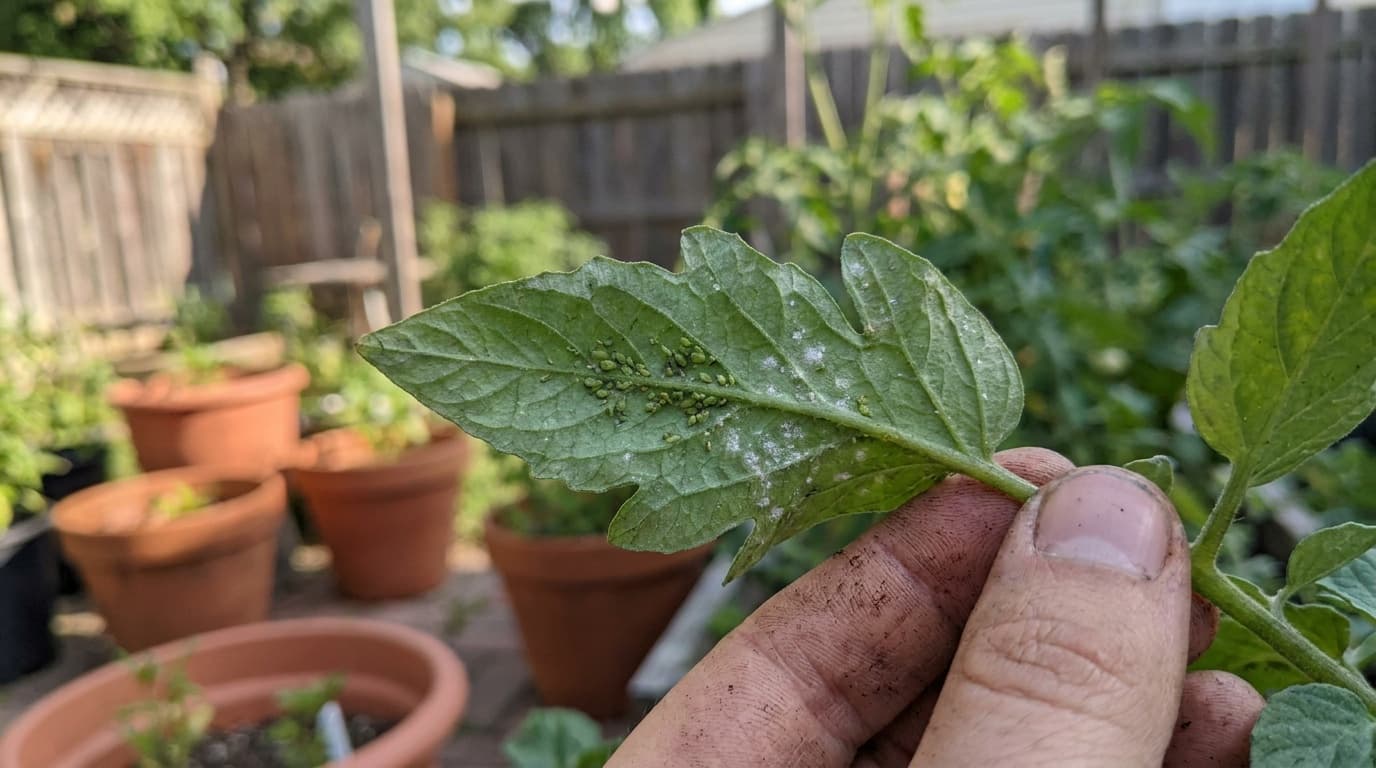
Aphids are 1 to 3 mm long, pear-shaped, and come in green, black, gray, pink, or pale yellow. Look on the newest leaves, growing tips, and the undersides of foliage, where they gather in dense clusters. Most species have a pair of tube-like projections (cornicles) at the rear, visible with a hand lens.
Telltale signs beyond the insects themselves:
Aphids hit a wide range of crops. You will most often find them on tomatoes, peppers, kale, cabbage, lettuce, and green beans, as well as on tender ornamental new growth.
What causes aphid outbreaks
Aphids thrive on soft, fast new growth, which is why over-fertilizing with high-nitrogen feed often triggers a bloom of them. Warm, sheltered, still air helps too. Outbreaks also follow when their natural predators are absent, which commonly happens after a broad-spectrum insecticide has wiped out the beneficial insects along with the pests.
How to get rid of aphids
Work through these in order. Most gardens never need to go past step two.
The aphid fix, in order
Blast them off
Treat survivors with insecticidal soap
Recruit predators
Deal with the ants
Prune heavy infestations
How to prevent aphids
Prevention comes down to not handing aphids the soft growth they love, and keeping their predators around.
- Go easy on nitrogen. Feed for steady growth, not a flush of soft new shoots.
- Inspect new transplants and the undersides of leaves weekly so you catch colonies while they are small.
- Plant a strip of flowering insectary plants (alyssum, dill, fennel, yarrow) to host beneficial insects all season.
- Use a floating row cover over young, vulnerable crops to physically exclude aphids and other flying pests until plants are established or need pollination.
Some links on this page are affiliate links. As an Amazon Associate I earn from qualifying purchases.
Pest exclusion
Agribon AG-19 Floating Row Cover
Best for: Gardeners who want cheap frost protection and pest exclusion in one fabric.
Keep in mind: Lightweight fabric tears and wears over seasons
Amazon price as of the checked date, subject to change. The price on Amazon at checkout applies.
Full research
- Weight
- 0.55 oz per sq yd
- Frost protection
- Down to roughly 28F
- Light transmission
- About 85%
- Material
- Spun-bonded polypropylene
A lightweight spun-bonded row cover that drapes over crops to add a few degrees of frost protection while still letting in light and water. It doubles as a physical barrier against many insect pests.
This catalog-wide research score is separate from this guide's use-case ranking. How we research
Strengths
- Extends the growing season at both ends
- Excludes many pests without chemicals
- Passes most light and water so it can stay on
Weaknesses
- Lightweight fabric tears and wears over seasons
- Needs hoops or pins to stay put in wind
Sprout Score breakdown
Best for
Gardeners who want cheap frost protection and pest exclusion in one fabric.
Row cover is most useful on young brassicas and leafy greens, where you can keep it on for weeks since those crops do not need pollination. Remove it from fruiting crops like tomatoes and beans once they flower. For timing transplants and knowing when young plants are most vulnerable, work from your planting calendar.
FAQ
What is the fastest way to get rid of aphids?
A strong spray of water is the fastest single action. It physically knocks aphids off the plant, and most cannot climb back. Repeat every two to three days and follow up with insecticidal soap on any clusters that remain. This works faster and more safely than reaching for a chemical insecticide.
Should I use dish soap on aphids?
Use a labeled insecticidal soap instead. Household dish detergents vary in concentration and additives and can damage leaf tissue, while the product label tells you which plants it can be used on, how much to apply, and when to repeat it.
Will aphids go away on their own?
Often yes, once natural predators like ladybugs, lacewings, and parasitic wasps build up. The catch is that predators lag behind the aphids by a week or two, so a young plant can be badly damaged in the meantime. Knocking the population down with water, then using labeled insecticidal soap only where needed, buys your plants time for the beneficials to catch up.
Why do I have so many ants around my aphids?
Ants feed on the sugary honeydew aphids produce, and in return they protect aphids from predators and even move them to fresh growth. If you see heavy ant traffic, control the ants with a sticky barrier around stems or trunks so beneficial insects can reach the aphids.
Are aphids harmful to humans or pets?
No. Aphids do not bite, sting, or carry disease that affects people or pets. They are purely a plant pest. The honeydew they leave is sticky and can encourage sooty mold, but it is harmless to handle.
Aphids look alarming in numbers, but they are among the easiest garden pests to manage without anything harsh. Knock them off, support the predators, and stay out of the way. For other sap-feeders that hide on leaf undersides, see how to handle spider mites.