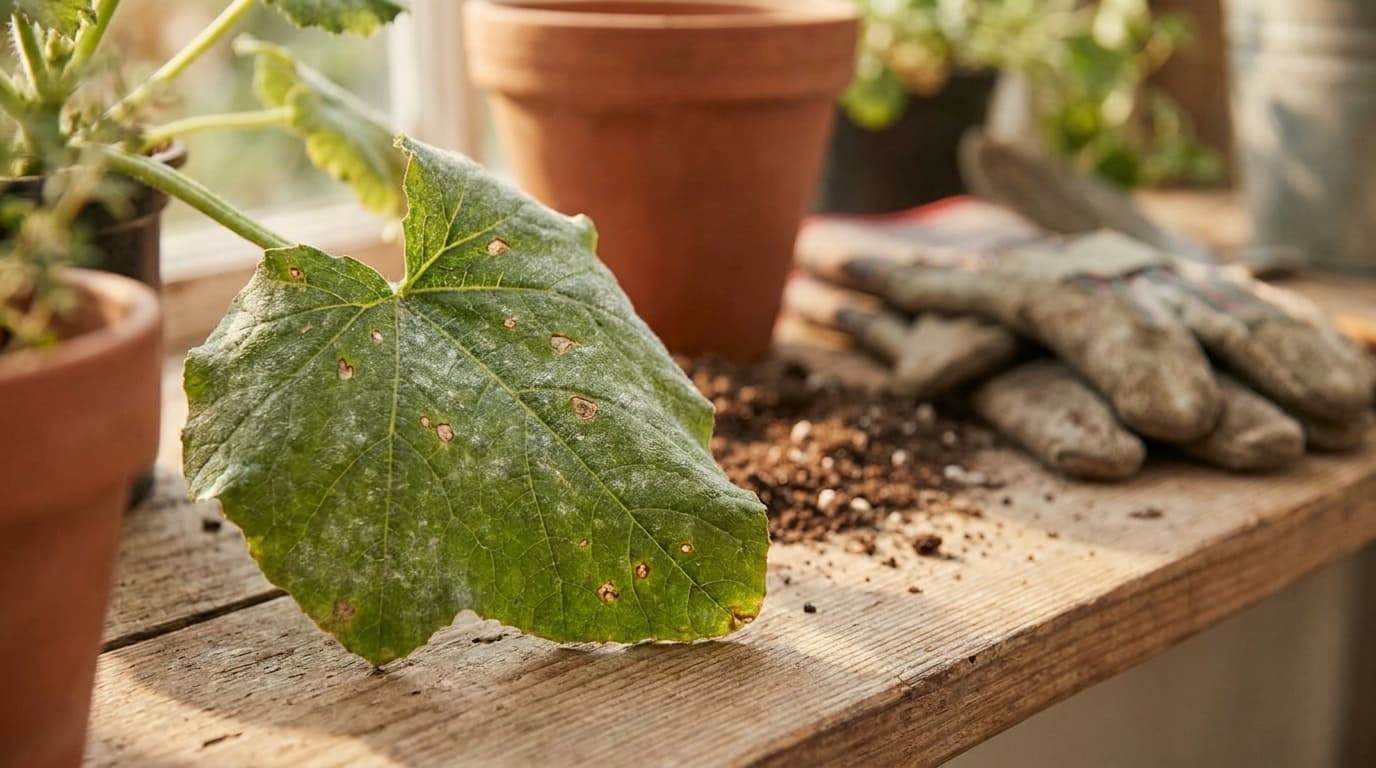
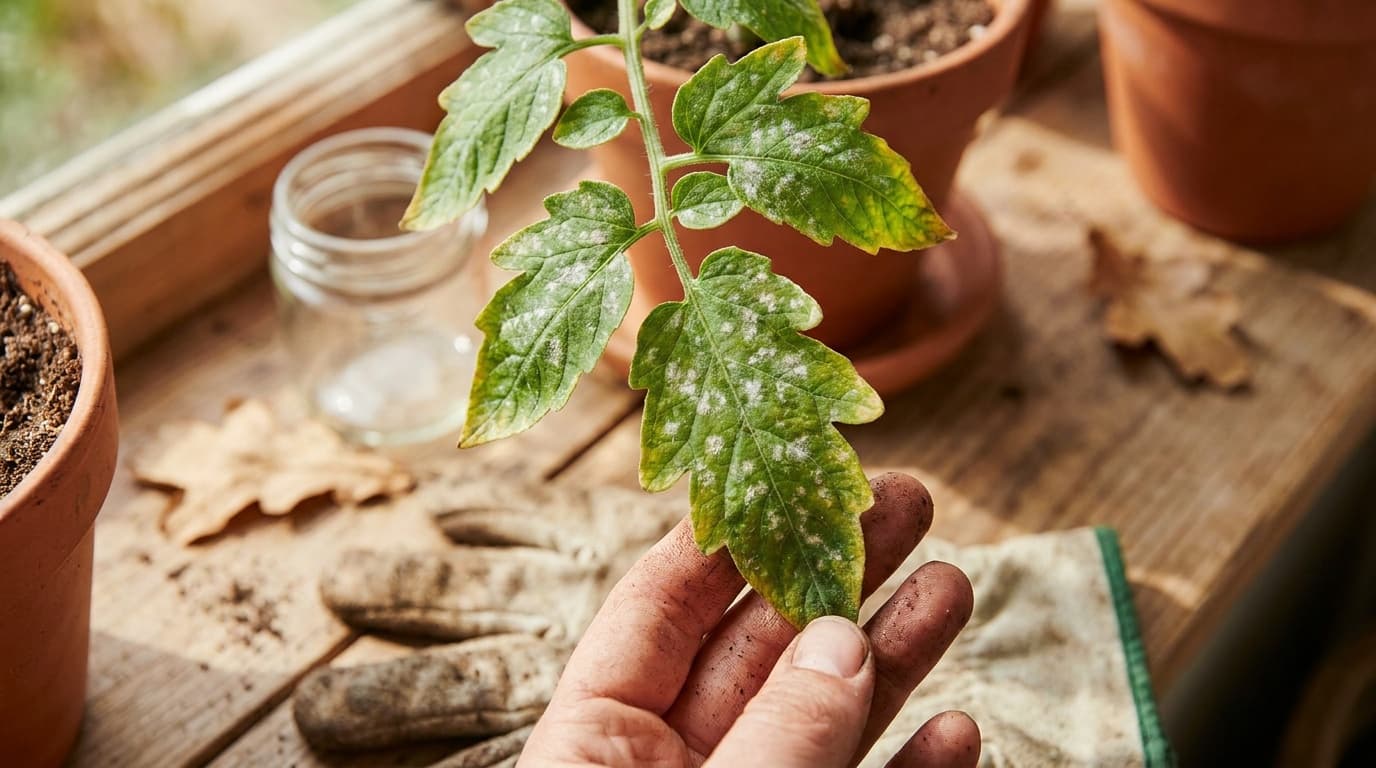
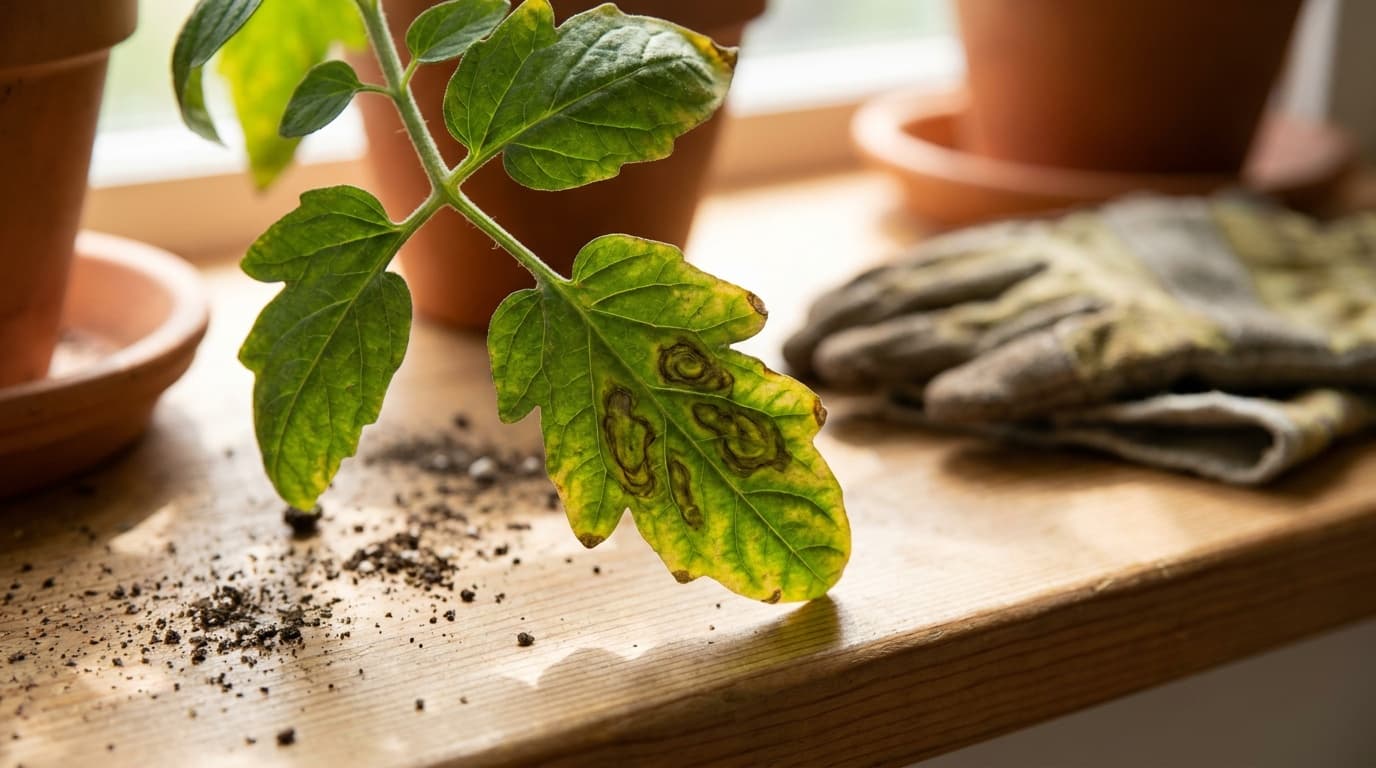
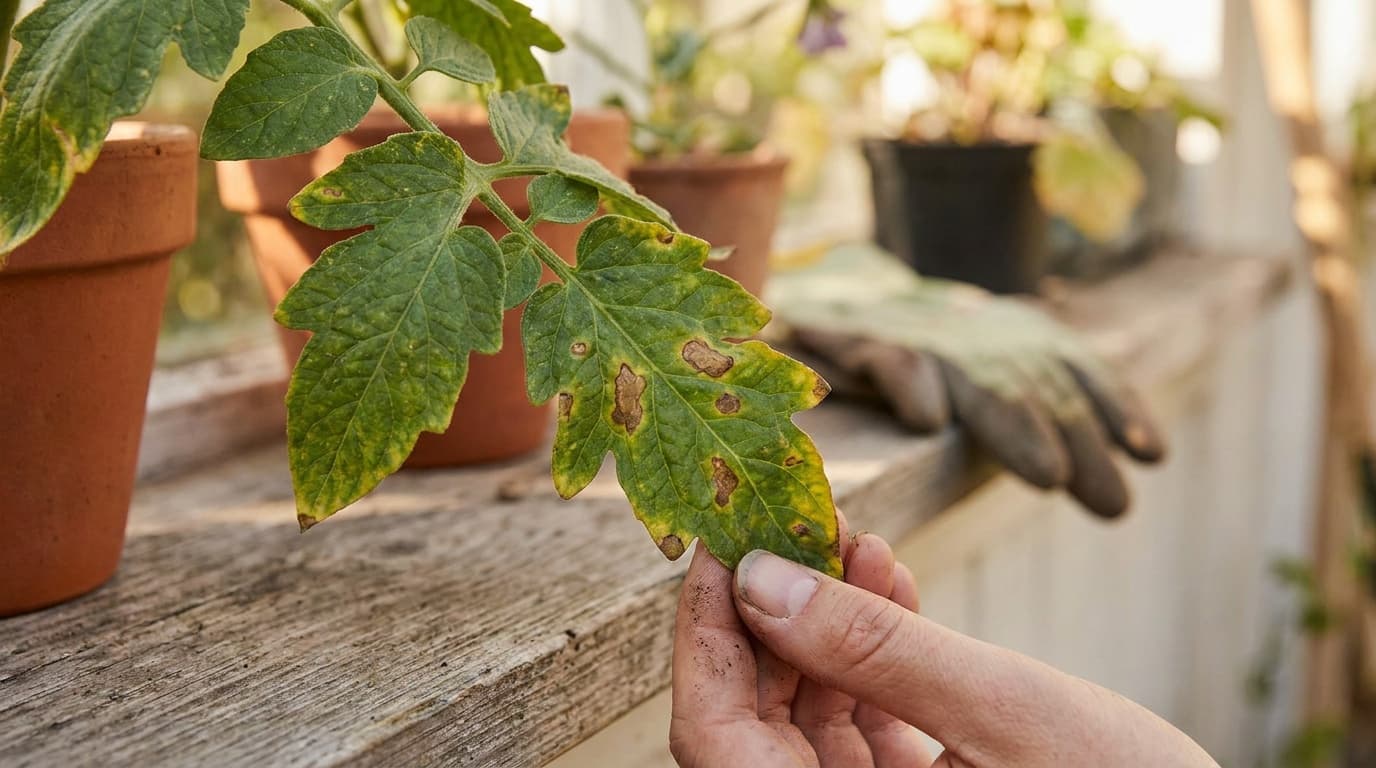
Septoria leaf spot is one of the two most common leaf diseases on home garden tomatoes, alongside early blight. The two are often confused. The quick tell: early blight makes a few large target-ring spots, while Septoria makes many small spots peppered across the leaf, each with a pale center and a scatter of pinpoint black dots. Both start low and climb, and both are managed the same way.
How to identify Septoria leaf spot
The signature is quantity and detail: lots of small, uniform, circular spots rather than a few big ones.
The pinpoint black dots in the spot centers are the most reliable identifier and separate Septoria from early blight, which makes larger concentric target rings. Septoria almost never spots the fruit; its damage is defoliation, which then exposes fruit to sunscald.
What causes Septoria leaf spot
Septoria is caused by a fungus that overwinters on infected tomato debris and on related weeds, and survives in the soil. In warm, wet weather, splashing rain and overhead water carry spores from the soil and from already-spotted lower leaves up onto healthy foliage. Persistent leaf wetness lets the spores germinate and infect.
The conditions that favor it:
- Splashing water. Rain and overhead watering move spores from the soil and lower leaves upward. This is the main spread route.
- Warm, humid, wet weather. Long periods of leaf wetness drive infection.
- Crowding and poor airflow. Dense plantings stay wet longer.
- Infected debris and weeds. Old tomato debris and related nightshade weeds harbor the fungus.
- Continuous tomato ground. Replanting tomatoes in the same spot lets the fungus build up.
How to manage Septoria leaf spot
There is no cure for spotted leaves, so every step protects the healthy upper foliage and the harvest.
Slowing Septoria leaf spot
Remove infected lower leaves
Mulch the soil
Water at the base, in the morning
Improve airflow
Rotate crops
The biggest controllable factor is keeping spores from splashing up off the soil and keeping the foliage dry. A flat soaker hose laid along the base of the row delivers water to the roots without wetting leaves and without the splash that overhead watering creates.
Some links on this page are affiliate links. As an Amazon Associate I earn from qualifying purchases.
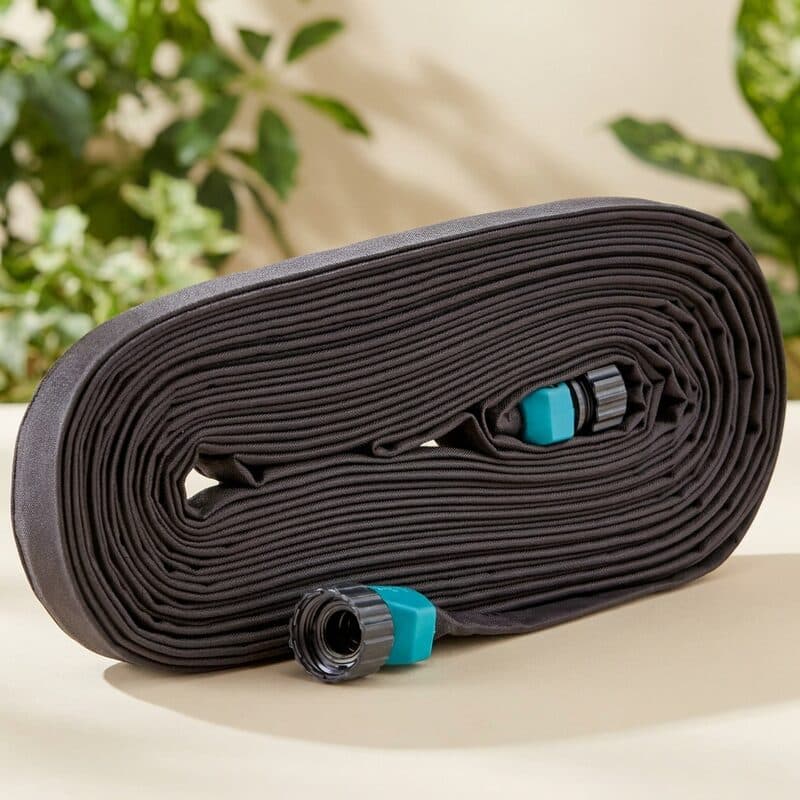
No leaf splash
Gilmour Flat Weeper Soaker Hose
Best for: Row and border gardeners who want low-waste, root-zone watering on a budget.
Keep in mind: Even output drops over very long runs and on slopes
Amazon price as of the checked date, subject to change. The price on Amazon at checkout applies.
Full research
- Type
- Flat weeper soaker hose
- Lengths
- Available in multiple lengths
- Delivery
- Seeps along the full length
- Connection
- Standard hose faucet
Gilmour's flat weeper soaker hose seeps water along its length to deliver moisture at the root zone, lying flat along rows and borders.
This catalog-wide research score is separate from this guide's use-case ranking. How we research
Strengths
- Delivers water directly to the root zone with little waste
- Flat profile lies neatly along rows and borders
- Inexpensive and easy to route through a bed
Weaknesses
- Even output drops over very long runs and on slopes
- Should be drained and stored to avoid winter damage
Sprout Score breakdown
Best for
Row and border gardeners who want low-waste, root-zone watering on a budget.
Owner rating snapshot
Amazon · 49 reviews · 4.2 stars
Watering early in the day on a timer keeps the lower leaves dry through the warm, humid hours when the fungus spreads, and a weather-aware timer skips a cycle after rain so the canopy is never needlessly wet.

Morning, weather-aware
Orbit B-hyve Smart Hose Faucet Timer
Best for: Gardeners who want app control and weather-aware automatic watering.
Keep in mind: WiFi setup can be finicky at the faucet's signal range
Amazon price as of the checked date, subject to change. The price on Amazon at checkout applies.
Full research
- Connectivity
- WiFi and Bluetooth
- Scheduling
- App-based, weather-adjusting
- Zones
- Single outlet (multi-outlet models available)
- Power
- Battery powered
Orbit's B-hyve smart timer adds WiFi and Bluetooth control with weather-based scheduling, automating faucet watering from a phone app.
This catalog-wide research score is separate from this guide's use-case ranking. How we research
Strengths
- Weather-based scheduling skips watering after rain
- Controllable from a phone over WiFi or Bluetooth
- Flexible programs for multiple watering windows
Weaknesses
- WiFi setup can be finicky at the faucet's signal range
- Costs more than a basic mechanical dial timer
Sprout Score breakdown
Best for
Gardeners who want app control and weather-aware automatic watering.
Owner rating snapshot
Amazon · 17 reviews · 4.1 stars
How to prevent Septoria leaf spot
- Rotate. Keep tomatoes out of last year's bed; 2 to 3 years is ideal.
- Mulch from the start. Block soil splash before symptoms appear.
- Space generously and prune the lower leaves so air moves and the bottom of the plant dries.
- Water at the base. Overhead watering is the most avoidable risk.
- Weed nearby nightshades that can harbor the fungus.
- Clean up at season's end. Remove and discard all tomato debris so the fungus has less to overwinter on.
- Time plantings well. Use the planting calendar so plants are vigorous and established before the warm, humid weather that favors the disease.
Which plants get Septoria leaf spot
Septoria leaf spot is overwhelmingly a tomato disease. It can occasionally affect eggplant, pepper, and potato, which are in the same plant family, but tomatoes are by far the main host. Related nightshade weeds also carry it, which is why weeding around the bed matters. This shared family susceptibility is one more reason to rotate.
What is the difference between Septoria leaf spot and early blight?
Both start on the lowest leaves and climb the plant, but the spots differ. Septoria makes many small, uniform round spots with pale gray or tan centers, dark borders, and tiny black dots in the center. Early blight makes fewer, larger spots with concentric rings, like a target or bullseye. The pinpoint black dots are the Septoria tell. The cultural management is essentially identical for both.
Can I save a tomato plant with Septoria leaf spot?
Usually yes. Septoria rarely kills the plant; it defoliates it from the bottom up, which weakens it and cuts yield. Remove the spotted lower leaves promptly, mulch to stop soil splash, water at the base, and improve airflow so the upper canopy stays healthy and keeps producing. There is no cure for the spotted leaves themselves, so the goal is to protect the new growth above.
Does Septoria leaf spot affect the tomato fruit?
Septoria attacks the leaves, not the fruit, so the fruit itself is rarely spotted and is safe to eat. The indirect harm is that heavy defoliation exposes fruit to the sun, which can cause sunscald, and a stripped plant produces less and ripens unevenly. Protecting the foliage protects the harvest.
How do I stop Septoria from spreading up the plant?
Break the splash-and-wet cycle. Mulch the soil to stop spores splashing up, water at the base in the morning instead of overhead so leaves stay dry, remove the infected lower leaves as they appear, and prune or stake for airflow so the canopy dries fast. Disinfect your snips between plants. These steps slow the climb; there is no spray that reverses leaves that are already spotted.
Septoria leaf spot is a chronic, manageable disease, not an emergency. Mulch to stop soil splash, water at the base, give plants air, strip the spotted lower leaves, and rotate your beds, and you will keep it from defoliating the plant.