Our recommendations

Hoss Stirrup Hoe
Why this pick →
Johnny's Selected Seeds Standard Collinear Hoe 7 in Fixed Blade
Why this pick →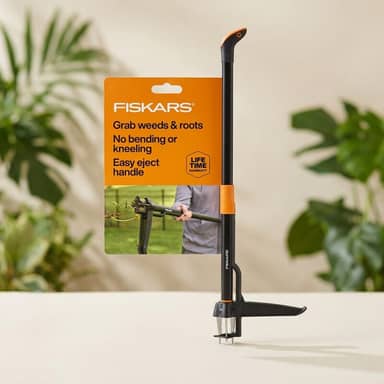
Fiskars Deluxe Stand-Up Weeder (4-Claw, Model 1023084)
Why this pick →
DeWit Long 3-Tine Cultivator
Why this pick →The difference between regular weeding and sporadic crisis weeding is almost always whether weeding is uncomfortable or easy. A long-handle hoe or cultivator lets you weed standing upright, covering a row in minutes rather than slowly crawling on your knees. This guide focuses on the tools that actually make weeding faster and more sustainable: the right blade geometry for your garden's layout, a handle long enough to keep you upright, and build quality that means the blade stays sharp across seasons.
Best overall: Hoss Stirrup Hoe

Best overall
Hoss Stirrup Hoe
Best for: Vegetable gardeners who do regular row weeding and want a durable, repairable US-made stirrup hoe.
Keep in mind: More expensive than imported stirrup hoes sold at hardware stores
Amazon price as of the checked date, subject to change. The price on Amazon at checkout applies.
Full research
- Blade width
- 6 in spring steel
- Blade action
- Oscillates 20 degrees, cuts both ways
- Handle
- 60 in waxed ash
- Overall length
- 65.5 in
The Hoss Stirrup Hoe features a 6-inch spring steel blade that oscillates 20 degrees to cut weeds on both the push and pull stroke, mounted on a waxed ash handle, and comes with a lifetime warranty and replaceable blades.
This catalog-wide research score is separate from this guide's use-case ranking. How we research
Strengths
- Oscillating blade cuts on the push and the pull, covering twice the ground per pass
- Made in the USA with a lifetime warranty and available replacement blades
- 60-inch handle suits a wide range of user heights without stooping
Weaknesses
- More expensive than imported stirrup hoes sold at hardware stores
- At 3 lb, slightly heavier than lightweight draw hoes for overhead-sensitive users
Sprout Score breakdown
Best for
Vegetable gardeners who do regular row weeding and want a durable, repairable US-made stirrup hoe.
The Hoss Stirrup Hoe earns its position because the oscillating blade is the most efficient blade geometry for row weeding in a vegetable garden. The 6-inch spring steel blade is mounted in a frame that allows it to pivot 20 degrees in either direction, so it cuts weeds on the push stroke and on the pull stroke. You cover twice the ground per pass compared to a fixed-blade hoe, and you weed in both directions of travel rather than having to reposition.
The frame and blade are powder-coated US-made steel, and the blade is spring steel: tough enough to flex slightly over rocks without snapping, and sharp enough to slice through young weeds cleanly. The 60-inch waxed ash handle is lacquer-free, which means it does not get slippery when your hands are dirty, and it is long enough for most heights to stand fully upright. Replacement blades are available when the original eventually dulls.
The Hoss Stirrup Hoe is not cheap. Comparable oscillating hoes from big-box stores exist at a fraction of the price, but owner feedback consistently confirms the quality difference: the Hoss blade holds its edge longer and the frame does not flex or loosen. For a gardener who weeds regularly, the price difference across a few seasons of use disappears.
Best for tight vegetable rows: Johnny's Collinear Hoe

Best for tight rows
Johnny's Selected Seeds Standard Collinear Hoe 7 in Fixed Blade
Best for: Gardeners with tightly spaced vegetable rows who want the most precise flat-blade weeding action available.
Keep in mind: Fixed blade requires hand-sharpening; a replaceable-blade version is available separately at higher cost
Amazon price as of the checked date, subject to change. The price on Amazon at checkout applies.
Full research
- Blade width
- 7 in (actual 6.75 in)
- Blade material
- Galvanized steel, fixed
- Overall length
- About 66 in (5.5 ft)
- Handle
- Oiled Maine ashwood
Johnny's collinear hoe, designed by Eliot Coleman, uses a galvanized steel blade that rides perfectly flat along the soil surface with a thumbs-up grip, delivering precise weed control between vegetable rows without throwing soil onto seedlings.
This catalog-wide research score is separate from this guide's use-case ranking. How we research
Strengths
- Blade travels collinear with the soil surface, slicing weeds cleanly without disturbing nearby seedlings
- Thumbs-up grip design allows upright posture and reduces back strain
- Precise 7-inch width fits common vegetable row spacings
Weaknesses
- Fixed blade requires hand-sharpening; a replaceable-blade version is available separately at higher cost
- Sold primarily through specialty garden suppliers rather than hardware stores
Sprout Score breakdown
Best for
Gardeners with tightly spaced vegetable rows who want the most precise flat-blade weeding action available.
The collinear hoe was designed by market farmer Eliot Coleman specifically for weeding tightly spaced vegetable rows without disturbing the seedlings on either side. The blade is a flat galvanized steel bar that rides perfectly parallel to the soil surface, and you hold the handle with a thumbs-up grip that keeps the blade angle constant. The result is a weeding action that shaves the weed roots just below the surface without throwing soil, without disturbing seedlings, and without requiring you to steer the blade with wrist rotation.
The Johnny's Standard Collinear Hoe is the most widely used version. The 7-inch fixed blade fits between rows spaced at 7 to 9 inches, which covers most vegetable row spacings for crops like lettuce, carrots, and onions. The oiled Maine ashwood handle runs to about 66 inches overall. Johnny's also offers a replaceable-blade version and a narrower 3 and 3/4 inch version for more tightly spaced rows.
The collinear hoe is a precision tool, not a power tool. It works best on young weeds in well-prepared soil. If your beds have not been weeded in weeks and the weeds are established, the stirrup hoe or a cultivator may be more effective for the initial clear. Once the bed is clean, regular passes with the collinear hoe keep it that way efficiently. This is the hoe that no-dig gardening practitioners and market gardeners reach for first.
Best for standing taproot removal: Fiskars Deluxe Stand-Up Weeder
Alternative Taproot weeder
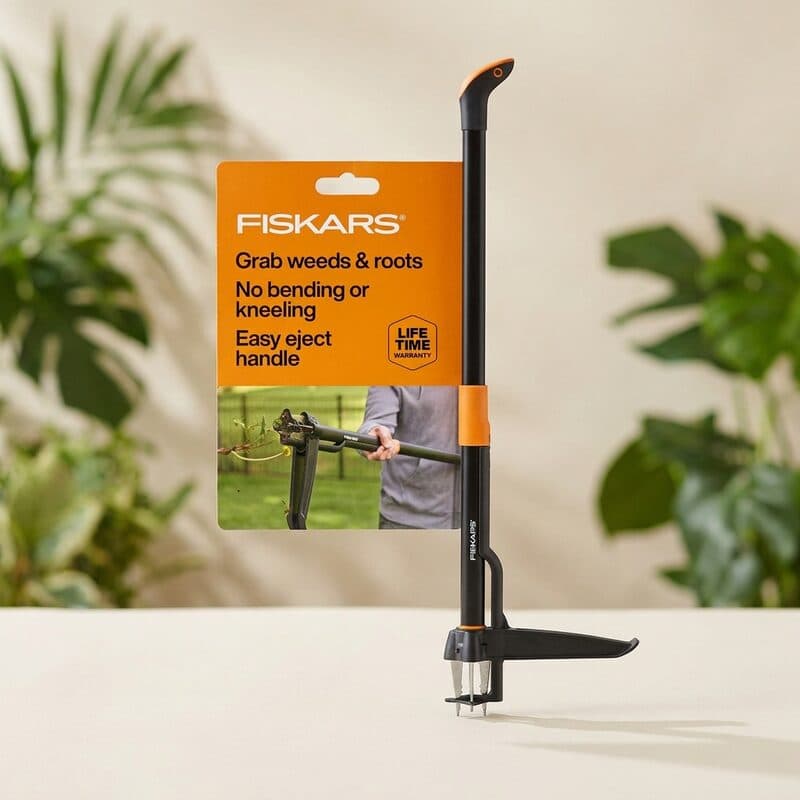
Fiskars Deluxe Stand-Up Weeder (4-Claw, Model 1023084)
Best for: Gardeners or lawn owners who want to remove taprooted weeds from paths, lawns, and open beds without stooping.
Keep in mind: Works best on isolated taprooted weeds (dandelion, thistle); less suited for dense mat weeds
Amazon price as of the checked date, subject to change. The price on Amazon at checkout applies.
Full research
- Handle length
- 39.25 in aluminum
- Claws
- 4 serrated stainless steel
- Foot platform
- Reinforced, for driving into soil
- Eject mechanism
- Lever in handle drops the weed
Fiskars' Deluxe Stand-Up Weeder uses four serrated stainless claws to grab taproot weeds and a lever-eject mechanism to drop them, removing dandelions and thistles from a fully upright standing position.
This catalog-wide research score is separate from this guide's use-case ranking. How we research
Strengths
- Step-and-twist action removes taproot weeds without bending or kneeling
- Easy-eject lever drops the weed without touching it
- Reinforced foot platform handles compacted soil better than earlier versions
Weaknesses
- Works best on isolated taprooted weeds (dandelion, thistle); less suited for dense mat weeds
- Not the right tool for weeding between tightly spaced plants where the claw head cannot fit
Sprout Score breakdown
Best for
Gardeners or lawn owners who want to remove taprooted weeds from paths, lawns, and open beds without stooping.
Owner rating snapshot
Amazon · 30 reviews · 4.4 stars
The Fiskars Deluxe Stand-Up Weeder solves a specific problem: removing dandelions, thistles, and other taprooted weeds from lawns and garden paths without kneeling or bending. You step on the foot platform to drive the four serrated stainless steel claws into the soil around the taproot, twist slightly to grip, then pull the long handle back to lever the weed out. A lever in the handle ejects the weed without you touching it.
This is not a row-weeding or cultivation tool. It is purpose-built for taproot extraction from open areas, and it does that job extremely well. The reinforced foot platform (a design upgrade from earlier models) handles compacted soil better than previous versions, and the 39-inch aluminum handle is enough to work fully upright. The lifetime warranty and widespread availability at Fiskars retail partners means service and replacement parts are not an issue.
The Fiskars stand-up weeder pairs well with any of the hoes above for a complete weeding system: use the stand-up weeder for occasional taproot weeds in the lawn and paths, and the stirrup or collinear hoe for routine vegetable bed maintenance. For hands-on taproot work in tight spaces, see our best hand weeders guide for the CobraHead and hori hori options.
Best for cultivation and weeding together: DeWit Long 3-Tine Cultivator

Companion 3-tine cultivator
DeWit Long 3-Tine Cultivator
Best for: Gardeners who maintain vegetable beds regularly and want a lightweight, long-handle cultivator built to last decades.
Keep in mind: Sold mainly through specialty garden tool retailers rather than hardware stores
Amazon price as of the checked date, subject to change. The price on Amazon at checkout applies.
Full research
- Total length
- 60 in
- Tines
- 3, Swedish boron steel, curved
- Tine width
- 3 in across
- Handle
- FSC-certified European ash
DeWit's Long 3-Tine Cultivator features hand-forged Swedish boron steel tines on a 60-inch ash handle, built in the Netherlands since 1898, and comes with a lifetime guarantee for breaking up surface crusting and uprooting young weeds.
This catalog-wide research score is separate from this guide's use-case ranking. How we research
Strengths
- Boron steel tines hold an edge better than standard carbon steel cultivators
- Light weight (1.5 lb) reduces fatigue over long cultivation sessions
- 60-inch handle allows upright posture for no-bend bed maintenance
Weaknesses
- Sold mainly through specialty garden tool retailers rather than hardware stores
- Three narrow tines cover less width per pass than a wider drag hoe
Sprout Score breakdown
Best for
Gardeners who maintain vegetable beds regularly and want a lightweight, long-handle cultivator built to last decades.
The DeWit Long 3-Tine Cultivator is what you reach for when you want to do more than weed: break up a surface crust after rain, aerate the top inch of a raised bed, work in a side dressing of compost, and knock out young weeds in the same pass. The three curved boron steel tines (the same Swedish boron steel used in bulldozer blades) are forged by DeWit in the Netherlands, a toolmaker in continuous production since 1898.
At 1.5 lb and 60 inches overall, it is one of the lightest long-handle cultivators available, which matters over an extended session maintaining several raised beds. The FSC-certified ash handle is unvarnished and comfortable. The lifetime guarantee from DeWit is meaningful: the brand stands behind its tools, and the forged boron steel construction means "wearing out" is not a realistic concern for most gardeners.
DeWit tools are sold through specialty garden retailers rather than most hardware stores. Three narrow tines also cover less width per pass than a flat hoe, so this tool is slow in large open areas. It works best with regular, precise weeding in raised beds and closely planted rows. Add a stirrup hoe for open ground.
How to choose a garden hoe
Blade geometry determines what the tool can do. An oscillating stirrup hoe cuts in two directions and covers rows efficiently. A collinear hoe is more precise and works between tightly spaced plants. A cultivator with tines loosens soil as well as weeds. A stand-up claw weeder is only for taproot extraction. No single blade does everything equally well.
Handle length matters more than most gardeners realize. A 60-inch handle is typically the right length for adults of average height to stand fully upright and work the blade with a comfortable grip. Shorter handles force you to bend, which recreates the back strain you bought the long-handle tool to avoid. Check the stated handle length before you buy.
Material and construction affect how long the blade stays sharp. Spring steel or boron steel hold edges better than stamped carbon steel. A forged blade is stronger than a stamped one. A tool that arrives sharp and stays sharp for a season is worth more than a budget alternative you sharpen monthly.
Match the tool to the stage of weed growth. Young weeds under an inch tall are sliced cleanly by a sharp stirrup or collinear hoe with minimal effort. Older weeds with established roots require more force and may need a heavier tool or hand-weeding with a hori hori or CobraHead. Weed early and weed often: the hardest weeding session is always the one after a long gap.
Raised beds and open ground are different. In a raised bed with loose, well-structured soil, a lightweight cultivator or collinear hoe is enough. In open ground or in-ground vegetable plots with more compaction, a stirrup hoe with a stiffer frame handles the resistance better.
| Product | Price | Best for | Buy |
|---|---|---|---|
| Hoss Stirrup Hoe#1 · BEST OVERALL | Typical price range · $50-$100 | Vegetable gardeners who do regular row weeding and want a durable, repairable US-made stirrup hoe. | Shop Amazon |
| Johnny's Selected Seeds Standard Collinear Hoe 7 in Fixed Blade#2 · BEST FOR TIGHT ROWS | Typical price range · $50-$100 | Gardeners with tightly spaced vegetable rows who want the most precise flat-blade weeding action available. | Search Amazon |
| Fiskars Deluxe Stand-Up Weeder (4-Claw, Model 1023084)Alternative · TAPROOT WEEDER | Typical price range · $50-$100 | Gardeners or lawn owners who want to remove taprooted weeds from paths, lawns, and open beds without stooping. | Shop Amazon |
| DeWit Long 3-Tine CultivatorCompanion · 3-TINE CULTIVATOR | Typical price range · $50-$100 | Gardeners who maintain vegetable beds regularly and want a lightweight, long-handle cultivator built to last decades. | Shop Amazon |
What is the most efficient hoe for weeding vegetable rows?
A stirrup hoe (also called a hula hoe or oscillating hoe) is typically the most efficient for weeding vegetable rows because the blade cuts on both the push and pull stroke, covering ground in both directions of travel. The Hoss Stirrup Hoe is one of the best-made US versions, with a 6-inch spring steel blade and a 60-inch handle. For very tight row spacings, a collinear hoe with a narrow blade is more precise.
What is a collinear hoe and who should use one?
A collinear hoe has a flat blade designed to travel parallel to the soil surface, slicing weeds just below ground without disturbing nearby plants or throwing soil. It uses a thumbs-up grip that keeps the blade angle consistent. It is the preferred weeding tool for market gardeners and serious home growers who plant in closely spaced rows of vegetables. If your rows are spaced 6 to 9 inches apart with crops like lettuce, carrots, or beets, the collinear hoe will weed them faster and with less collateral disturbance than any other tool.
Can I use a garden hoe in a raised bed?
Yes. A lightweight cultivating hoe or collinear hoe works well in raised beds with loose, well-structured soil. The key is matching the blade width to the spacing in your bed: a 7-inch collinear hoe for rows spaced around 7 to 9 inches, a narrower blade for tighter spacings. A stirrup hoe also works in raised beds and is especially useful for quick passes to knock back surface weeds before they establish. Avoid very heavy draw hoes in shallow raised beds, where deep soil disturbance can damage roots.
How do I sharpen a garden hoe?
Most flat-blade hoes sharpen with a flat bastard file or a diamond paddle file held at roughly 45 degrees to the blade's bevel. Work the file along the beveled (top or front) edge in smooth strokes, maintaining the existing angle. Remove any burr from the flat underside with a single light pass. A sharp hoe slices weeds cleanly; a dull one pushes them over. Sharpen before each major weeding session and the blade will stay effective all season. Spring-steel stirrup hoe blades may be replaced rather than sharpened when they eventually dull past a useful edge.
What is the difference between a stirrup hoe and a draw hoe?
A stirrup hoe (also called an oscillating or hula hoe) has a looped blade that pivots to cut on both the push stroke and the pull stroke. A draw hoe (the classic flat-blade garden hoe) cuts only on the pull stroke. The stirrup hoe is more efficient for surface weeding between rows because it works in both directions. The draw hoe is better for heavier tasks like hilling soil around potatoes, making planting furrows, or chopping through established weeds and root mats where you need more blade mass and control.
A long-handle weeding tool that fits your garden layout makes routine maintenance fast enough to actually happen. For the hands-on, close-quarters work the long-handle tools cannot reach, see our companion guide to best hand weeders. For a complete garden tool kit, our best garden trowels, best garden gloves, and best garden kneelers guides cover the other essentials. To plan the timing of your plantings and stay ahead of weed windows, the planting calendar has zone-specific schedules.