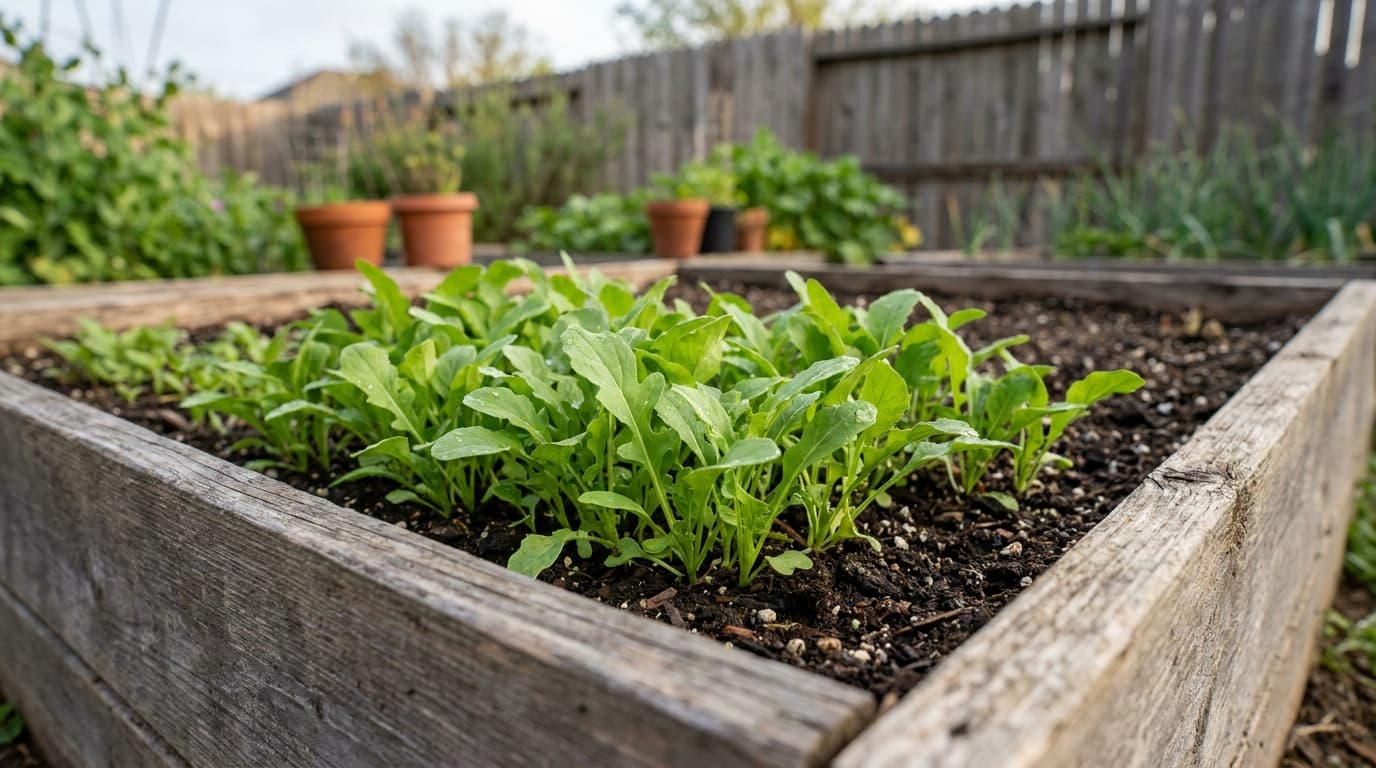
Arugula grows quickly enough that bed management matters more than elaborate care. A large stand can become coarse at once, while a few small sections give the kitchen a steadier supply. Its peppery flavor also changes as plants age and experience stress, so harvest decisions should follow taste and growth form rather than an arbitrary target size.
Use the arugula plant profile for exact local dates, bed layout, sowing depth, light and soil values, water rate, zone fit, and expected maturity. The profile and planting calendar own the lookup layer; this guide explains sowing workflow, crop protection, harvest, and troubleshooting.
Plan a sequence, not a glut
Divide the available bed into small sowing sections. Seed the next section while the current one is still producing, using the succession planting guide to coordinate arugula with the crops that will follow it. This creates several manageable harvests instead of one patch that reaches peak quality all at once.
Decide whether each section is for young leaves or mature rosettes. A young-leaf stand is managed as a group and cut evenly. A mature stand is thinned so individual plants can be harvested from the outside. Use the exact bed layout in the profile for the chosen style.
Arugula also fits naturally beside lettuce and spinach in a salad rotation, but keep each crop in a distinct section. Their rates of growth and decline differ, and a mixed scatter is harder to weed, inspect, and harvest cleanly.
Sow into a fine surface
Work finished compost into a well-drained bed, then rake the surface smooth. Break crusted soil and remove debris that creates dry pockets. Sow directly and water with a gentle pattern so seed remains where placed.
Once seedlings are established, thin by snipping extras at soil level. Pulling can lift the roots of neighboring plants. Keep the bed weeded while weeds are small, because distinguishing them from densely sown arugula becomes harder after leaves overlap.
Stop flea beetles before they start
Flea beetles chew many small holes in tender arugula leaves. Established plants may continue growing, but damaged foliage loses kitchen value. Exclusion is more effective than trying to repair a mined-looking stand after feeding begins.
Install floating row cover over a clean seedbed immediately after sowing. Leave enough slack for growth and seal the edges against the soil. Inspect underneath regularly, because beetles trapped inside the barrier gain protected access to the crop.
Some links on this page are affiliate links. As an Amazon Associate I earn from qualifying purchases.
Flea beetle barrier
Agribon AG-19 Floating Row Cover
Best for: Gardeners who want cheap frost protection and pest exclusion in one fabric.
Keep in mind: Lightweight fabric tears and wears over seasons
Amazon price as of the checked date, subject to change. The price on Amazon at checkout applies.
Full research
- Weight
- 0.55 oz per sq yd
- Frost protection
- Down to roughly 28F
- Light transmission
- About 85%
- Material
- Spun-bonded polypropylene
A lightweight spun-bonded row cover that drapes over crops to add a few degrees of frost protection while still letting in light and water. It doubles as a physical barrier against many insect pests.
This catalog-wide research score is separate from this guide's use-case ranking. How we research
Strengths
- Extends the growing season at both ends
- Excludes many pests without chemicals
- Passes most light and water so it can stay on
Weaknesses
- Lightweight fabric tears and wears over seasons
- Needs hoops or pins to stay put in wind
Sprout Score breakdown
Best for
Gardeners who want cheap frost protection and pest exclusion in one fabric.
Leaf miners leave pale winding tunnels rather than surface holes. Remove affected leaves and use the leaf miner guide to interrupt the life cycle. Aphids cluster on leaf undersides and can often be dislodged with a firm water spray followed by another inspection.
Keep flavor and texture in range
Check root-zone moisture frequently and irrigate before leaves wilt. Dry soil can intensify sharpness and toughen foliage, while saturated soil limits root function. Direct water at the soil and allow the canopy to dry promptly.
Compost-amended soil often supports a short arugula crop without extra feeding. If an entire stand becomes pale while roots and drainage remain healthy, a modest balanced side-dressing may help. Avoid pushing soft growth with excess fertilizer, especially when the stand is already nearing the end of its useful phase.
Taste a representative leaf during harvest rounds. Pepperiness varies by variety and plant condition, and the kitchen's preference is more useful than a universal flavor claim. If leaves become too strong for salads, they may still work in pesto, wilted dishes, or as a smaller accent.
Harvest according to the stand
For individual plants, take the oldest tender outer leaves and preserve the center. For a young-leaf stand, gather the foliage and cut above the crowns so clean regrowth remains possible. Use a sharp knife or scissors and avoid dragging soil across the cut leaves.
Harvest after surface moisture has dried, then cool the leaves promptly. Remove damaged or heavily mined foliage in the garden so it does not complicate kitchen cleaning.
Once the center begins to rise, taste the leaves and make a quick decision. Bolting is not reversible. Harvest usable foliage, or leave selected plants only if you want flowers and seed. Arugula flowers are edible and carry the plant's peppery character, but a flowering plant should no longer be counted as the salad bed's main leaf producer.
Troubleshoot the pattern of damage
Arugula field checks
Many tiny round holes
Pale tunnels inside leaves
Leaves are very sharp or coarse
Patchy emergence
Center begins to rise
Why does my arugula taste unusually bitter or sharp?
Flavor intensifies as leaves age and when plants are stressed or beginning to bolt. Taste the youngest healthy leaves, correct active moisture stress, and harvest promptly if the center is elongating.
How do I keep flea beetles off arugula?
Cover a clean seedbed before beetles arrive, seal the edges, and inspect underneath. If beetles are already present, remove them before replacing the cover so the barrier does not protect the infestation.
Can arugula grow back after cutting?
Yes, if the cut stays above the crowns and the plants have not begun bolting or declined from stress. Keep the root zone steady and evaluate the next flush for tenderness before planning another cut.
What should I do after arugula starts bolting?
Harvest any leaves that still taste good, then clear the stand or keep selected plants for edible flowers and seed. More water or fertilizer will not return the plant to compact leaf growth.
Arugula works best as a rhythm: prepare a small section, exclude pests, taste and cut it, then move to the next. That rhythm gives the crop a clear job before bolting changes it.