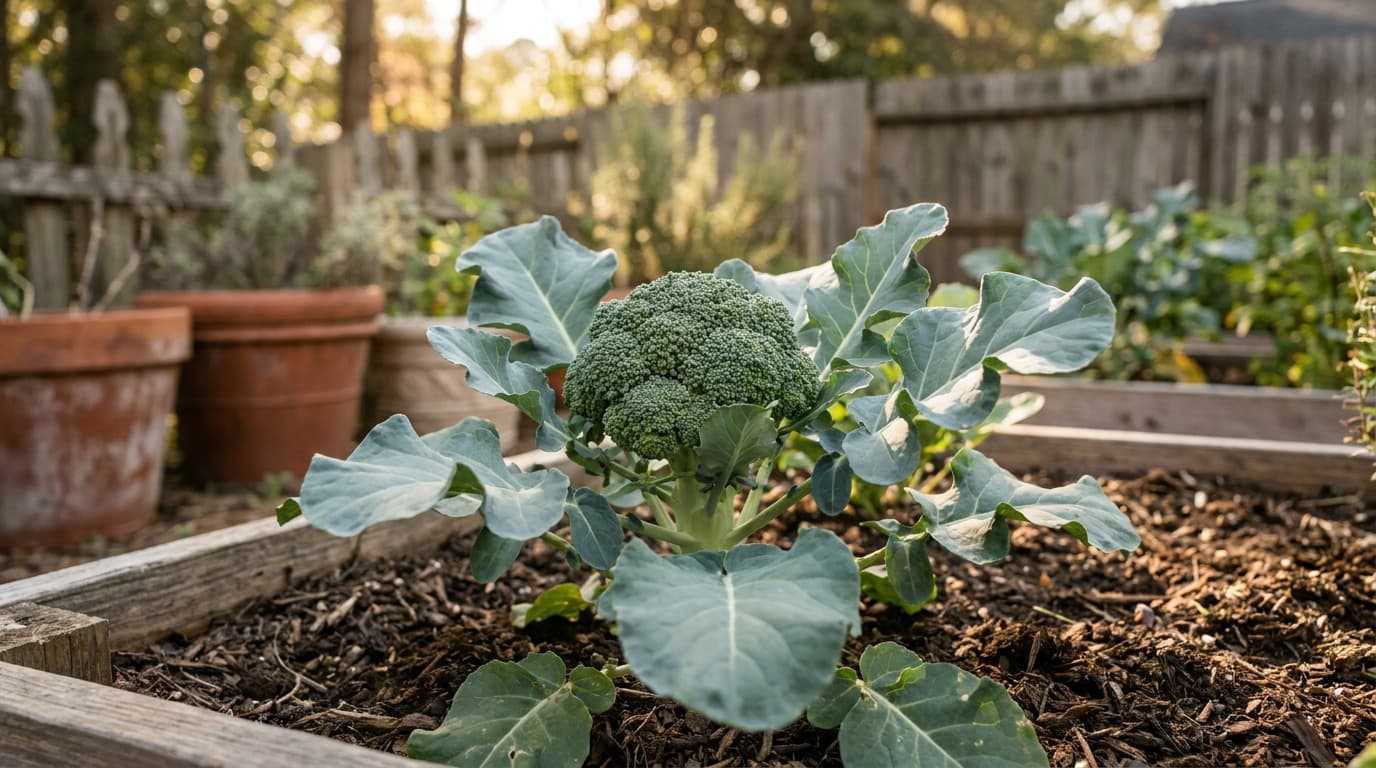
Broccoli is not difficult because it needs constant attention. It is difficult because several small stresses can interrupt head formation. A root-bound transplant, dry soil followed by a soaking, or unnoticed caterpillar damage can turn a promising plant into a small or loose head. The useful strategy is continuity: make the move into the garden gentle, keep growth even, and inspect often enough to act while problems are still small.
For exact local dates, bed layout, sowing depth, light and soil values, water rate, zone fit, and expected maturity, use the broccoli plant profile. The profile is the lookup layer; this guide focuses on what to do with the plant in front of you.
Prepare a bed for uninterrupted growth
Choose a bed that drains after rain but does not dry abruptly. Work finished compost into the surface before planting and break up dense clods so new roots can leave the transplant plug easily. Avoid fresh manure and heavy last-minute fertilizer applications. Broccoli benefits from fertile soil, but a sudden flush of soft leaf growth can make pest damage harder to manage and does not guarantee a better head.
If brassicas occupied the bed recently, move broccoli elsewhere. Broccoli shares soilborne disease and pest pressure with cabbage, kale, cauliflower, collards, turnips, and related crops. Rotate the family as a group rather than treating each vegetable as unrelated. The home garden crop rotation guide shows how to organize that move.
Water the transplant tray before planting. A moist, cohesive root ball slides out with less tearing than a dry one. If roots circle densely around the plug, tease only the outermost roots loose. Severe pulling causes another growth check. Set the plant firmly, close air pockets with the surrounding soil, and water the root zone gently.
Protect the crop from the start
Young broccoli can lose a surprising amount of leaf area before damage is obvious from a distance. Install floating row cover as soon as the crop is planted if cabbage worms, loopers, flea beetles, or root maggots are common in your garden. Seal the edges with soil, boards, or pins so insects cannot walk underneath, and leave enough slack for the plants to lift the fabric as they grow.
Some links on this page are affiliate links. As an Amazon Associate I earn from qualifying purchases.
Transplant protection and pest barrier
Agribon AG-19 Floating Row Cover
Best for: Gardeners who want cheap frost protection and pest exclusion in one fabric.
Keep in mind: Lightweight fabric tears and wears over seasons
Amazon price as of the checked date, subject to change. The price on Amazon at checkout applies.
Full research
- Weight
- 0.55 oz per sq yd
- Frost protection
- Down to roughly 28F
- Light transmission
- About 85%
- Material
- Spun-bonded polypropylene
A lightweight spun-bonded row cover that drapes over crops to add a few degrees of frost protection while still letting in light and water. It doubles as a physical barrier against many insect pests.
This catalog-wide research score is separate from this guide's use-case ranking. How we research
Strengths
- Extends the growing season at both ends
- Excludes many pests without chemicals
- Passes most light and water so it can stay on
Weaknesses
- Lightweight fabric tears and wears over seasons
- Needs hoops or pins to stay put in wind
Sprout Score breakdown
Best for
Gardeners who want cheap frost protection and pest exclusion in one fabric.
Lift the cover for inspection instead of assuming the barrier makes the bed maintenance-free. Look beneath leaves for eggs, small caterpillars, aphid colonies, and fresh feeding. Hand-pick isolated caterpillars. For a larger active infestation, follow the control sequence in the imported cabbage worm or cabbage looper guide.
Row cover works only when pests are not already trapped beneath it. If the bed recently held brassicas, inspect the soil and transplants carefully before covering. Crop rotation remains the stronger defense against recurring root and disease problems.
Keep leaves and roots in balance
Broccoli should keep producing firm, evenly colored leaves as it builds the central head. Check the soil by touch and irrigate before the root zone swings from dry to saturated. Aim water at the soil rather than repeatedly wetting the foliage. Mulch can soften moisture swings and reduce weed competition, but keep it clear of the stem so the crown stays dry.
Use plant appearance to decide whether feeding is needed. Deep green leaves and steady new growth usually mean the bed is supplying enough. Pale leaves across the plant, combined with slow growth and no sign of root damage, can justify a modest side-dressing with a balanced fertilizer. Keep fertilizer away from the stem and water it into the surrounding soil.

Balanced organic feed
Down to Earth All Purpose Mix 4-6-2
Best for: Organic gardeners who want a balanced, plastic-free all-purpose feed.
Keep in mind: Sometimes harder to find in big-box stores
Amazon price as of the checked date, subject to change. The price on Amazon at checkout applies.
Full research
- NPK
- 4-6-2
- Type
- Granular organic blend
- Use
- All-purpose: vegetables, flowers, herbs
- Packaging
- Compostable cardboard box
A balanced 4-6-2 all-purpose organic fertilizer blended from quality natural inputs and sold in a compostable box. A versatile feed for vegetable gardens, flower beds, and herbs.
This catalog-wide research score is separate from this guide's use-case ranking. How we research
Strengths
- Balanced all-purpose organic formulation
- Compostable, plastic-free packaging
- No synthetic additives or fillers
Weaknesses
- Sometimes harder to find in big-box stores
- Organic granules release slowly
Sprout Score breakdown
Best for
Organic gardeners who want a balanced, plastic-free all-purpose feed.
Do not reach for fertilizer when a plant wilts in wet soil, has a damaged stem, or shows distorted roots. Those symptoms point to drainage, disease, or pest injury. More nutrients will not repair them and may complicate diagnosis.
Read head development correctly
A healthy main head feels dense and shows small, closed buds. Harvest before the buds loosen, swell unevenly, or show yellow petals. Use a clean knife and cut the stalk below the head, leaving as much healthy leaf and stem on the plant as practical.
That remaining plant is still productive. Broccoli commonly forms smaller side shoots from leaf joints after the main head is removed. Continue ordinary moisture care and inspect the new shoots during regular garden rounds. Cutting them promptly encourages the plant to keep producing until quality declines or the crop is removed.
Loose or unusually small heads often trace back to an earlier interruption rather than a harvest mistake. Review transplant condition, moisture swings, root health, and severe leaf loss. The broccoli profile can confirm whether the selected variety and local growing window were a good match, while this guide helps identify the management issue.
Troubleshoot symptoms before treating
Broccoli field checks
Small central head
Loose buds
Chewed leaves
Plant wilting in moist soil
Yellow lower leaves
For swollen, distorted roots and midday wilting, see clubroot. For seedlings that collapse near the soil line, use the damping-off guide. Removing badly diseased plants and rotating future brassicas is more useful than repeatedly treating a failing bed.
Why did my broccoli make a small head?
A small head usually follows a growth interruption. Root-bound transplants, rough handling, moisture swings, root injury, and heavy caterpillar feeding are common causes. Review the plant's history and correct the active stress. Heavy feeding after the head has formed will not rebuild it.
How can I keep caterpillars out of broccoli heads?
Install floating row cover before adult moths can lay eggs, keep the edges sealed, and inspect leaf undersides during routine care. If caterpillars are already present, remove them before replacing the cover and follow the relevant pest guide for a larger infestation.
How can I tell that a broccoli head is ready to cut?
Cut while the head is firm and the individual buds remain compact and closed. Loosening buds or the first hint of petals means quality is beginning to decline, so harvest rather than waiting for a larger head.
Will broccoli produce after the main head is harvested?
Often, yes. Leave the stem, leaves, and roots in place after cutting the central head. Healthy plants can form smaller side shoots at the leaf joints, giving several follow-up harvests with the same care.
Give broccoli a strong root system, exclude pests early, and keep growth steady. Harvest while the buds are tight. After cutting the main head, leave the plant in place to produce side shoots.