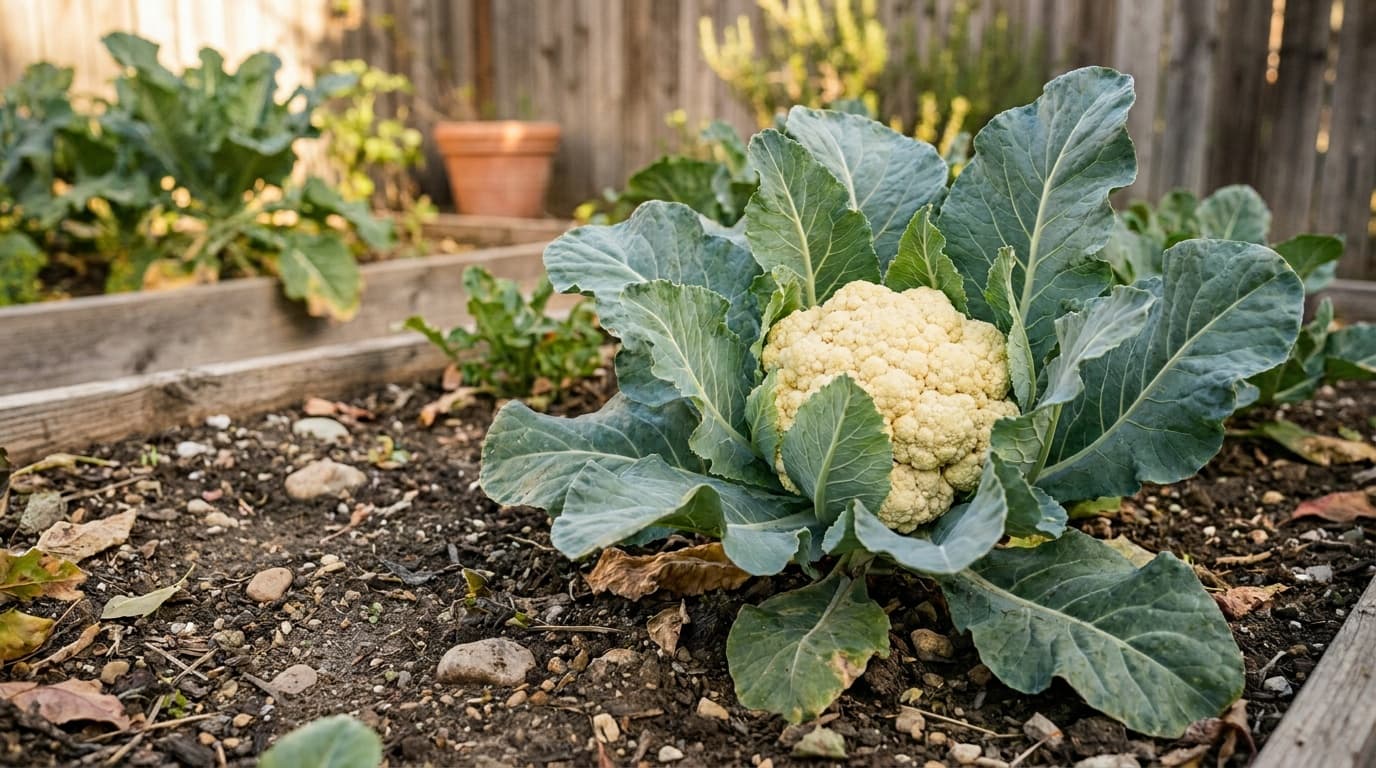
Cauliflower has a reputation for being temperamental because the harvested curd records the plant's entire growing experience. A stressed young plant may form a tiny button. A damaged canopy may expose the curd. A delay at harvest can turn a dense surface into loose, grainy segments. The answer is not constant tinkering. It is a calm sequence that prevents setbacks and makes the final harvest decision on time.
Use the cauliflower plant profile for exact local dates, bed layout, sowing depth, light and soil values, water rate, zone fit, and expected maturity. This guide covers preparation, transplant technique, curd management, and diagnosis.
Build the crop before the curd appears
Cauliflower needs a broad, healthy leaf canopy before it can make a good curd. Start with transplants that are compact and actively growing rather than root-bound or already stressed. Acclimate them gradually to outdoor conditions, water the tray before planting, and handle each plant by its leaves or root plug rather than squeezing the stem.
Prepare the bed with finished compost and remove dense clods. Soil should hold moisture while still draining after irrigation or rain. If the bed recently grew cabbage-family crops, choose another location. Cauliflower shares clubroot, root maggots, caterpillars, and several foliar diseases with broccoli, cabbage, kale, collards, turnips, and Brussels sprouts. Move the whole family together in your crop rotation plan.
After planting, press the surrounding soil gently around the root plug and water it in. Watch for a prompt return to upright, active growth. A plant that remains limp despite moist soil needs inspection at the stem and roots, not another round of irrigation.
Protect the working leaves
The large outer leaves are not waste. They are the plant's energy system and later become the curd's shelter. Install floating row cover at planting if flea beetles, cabbage worms, loopers, or root maggots are regular visitors. Seal the edges and provide enough slack for expansion.
Some links on this page are affiliate links. As an Amazon Associate I earn from qualifying purchases.
Pest and frost shield
Agribon AG-19 Floating Row Cover
Best for: Gardeners who want cheap frost protection and pest exclusion in one fabric.
Keep in mind: Lightweight fabric tears and wears over seasons
Amazon price as of the checked date, subject to change. The price on Amazon at checkout applies.
Full research
- Weight
- 0.55 oz per sq yd
- Frost protection
- Down to roughly 28F
- Light transmission
- About 85%
- Material
- Spun-bonded polypropylene
A lightweight spun-bonded row cover that drapes over crops to add a few degrees of frost protection while still letting in light and water. It doubles as a physical barrier against many insect pests.
This catalog-wide research score is separate from this guide's use-case ranking. How we research
Strengths
- Extends the growing season at both ends
- Excludes many pests without chemicals
- Passes most light and water so it can stay on
Weaknesses
- Lightweight fabric tears and wears over seasons
- Needs hoops or pins to stay put in wind
Sprout Score breakdown
Best for
Gardeners who want cheap frost protection and pest exclusion in one fabric.
Inspect under the cover during routine care. Remove caterpillars and eggs before replacing it, and repair tears or lifted edges. If chewing is already widespread, use the imported cabbage worm and cabbage looper guides to identify the pest and choose a response.
Keep weeds from competing at the base, but cultivate shallowly. Cauliflower roots near the soil surface can be injured by aggressive hoeing. A light mulch can suppress weeds and moderate moisture changes without disturbing those roots.
Manage moisture and fertility by plant response
Cauliflower dislikes alternating neglect and rescue. Check the root zone regularly and irrigate before the bed becomes dry enough to check growth. Water the soil instead of repeatedly wetting the leaves and center of the plant. Good drainage matters just as much as consistent moisture because saturated roots cannot support healthy leaf growth.
Fertility decisions should follow the foliage. A vigorous plant with evenly colored leaves does not need speculative feeding. If the entire plant becomes pale and growth slows while drainage and roots look healthy, use a modest balanced side-dressing around the active root zone. Avoid piling fertilizer against the stem.
Blanch white curds without trapping moisture
Blanching is a physical shading technique for varieties whose leaves do not naturally cover the curd. It keeps a white curd from yellowing in direct light. Colored varieties and self-wrapping white varieties may not need this step, so check the seed packet and observe the canopy before intervening.
Once the curd is clearly visible but still compact, bring several clean outer leaves over it. Tuck them together or secure them loosely so air can move and rainwater can escape. Do not tie the bundle tightly. A sealed, wet pocket encourages decay and hides changes in the curd.
If leaves naturally curl over the curd, let them do the work. Unnecessary tying can snap petioles or create a damp chamber. The goal is shade, not compression.
Harvest by texture, not anticipation
An ideal curd looks dense and uniform, with tightly packed segments and no obvious separation. Cut it while that compact texture holds. Waiting for more size after the surface begins to loosen reduces quality rather than improving yield.
Use a clean knife to remove the curd with a protective collar of leaves. The leaves help shield it during handling. Cool the harvest promptly and avoid bruising the surface. Unlike broccoli, cauliflower usually produces little from side shoots, so clear the plant after harvest and keep diseased material out of the compost.
Diagnose the shape of the failure
Cauliflower field checks
Tiny button-like curd
Loose or grainy surface
Yellowed white curd
Brown or soft patches
Wilting with wet soil
Swollen roots and recurring wilt suggest clubroot. Seedlings that pinch off near the soil line point toward damping off. Repeated caterpillar feeding should be handled with identification and exclusion, not broad preventive spraying.
Why did my cauliflower form a tiny curd?
This is commonly called buttoning. It usually follows a serious growth check while the plant is young, such as a root-bound transplant, abrupt hardening, damaged roots, or severe moisture stress. Correct any active problem, but recognize that the existing curd may not enlarge normally.
Does every cauliflower curd need blanching?
No. Many colored varieties and some white varieties shelter their own curds. Blanch only when the variety and canopy leave a white curd exposed. Use clean leaves as a loose shade cover and keep air moving around the curd.
Why is the cauliflower curd turning loose and grainy?
The curd has moved past its best compact stage or has been stressed during development. Harvest it promptly. Extra water or fertilizer cannot make separated segments knit together again.
How do I know the curd is ready to harvest?
Judge the surface rather than waiting for a target size. A ready curd is firm, dense, and tightly segmented. Cut before the sections begin to separate or the surface loses its compact texture.
Cauliflower becomes more predictable when each stage has one job: establish roots gently, protect the canopy, keep growth steady, shade only when the variety needs it, and cut while the curd is compact.