Our recommendations
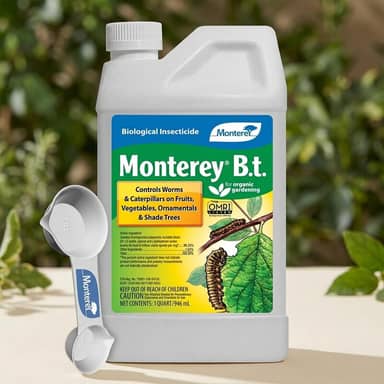
Monterey B.t. Biological Insecticide Concentrate
Why this pick →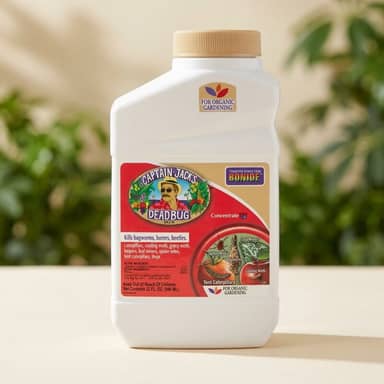
Bonide Captain Jack's Deadbug Brew Concentrate
Why this pick →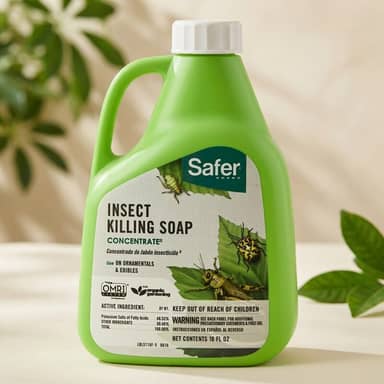
Safer Brand Insect Killing Soap Concentrate
Why this pick →
Bonide Captain Jack's Neem Oil Concentrate
Why this pick →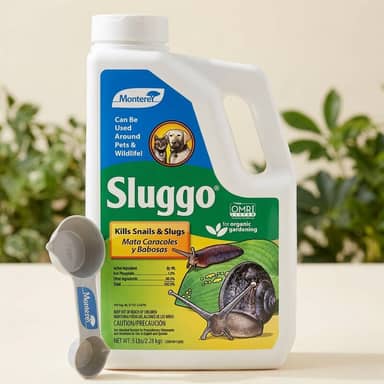
Monterey Sluggo Slug and Snail Killer
Why this pick →Organic pest control for vegetables comes down to matching the right product to the right pest. No single spray covers everything, and reaching for the wrong one wastes time and money. The good news: five well-chosen, OMRI-listed products cover almost every common vegetable garden pest without synthetic chemistry, and most are safe to apply up to harvest day.
This guide covers the lineup: what each product targets, when to use it, and what it will not do. Before spraying anything, read our organic pest control basics for a framework on prevention first.
Best for caterpillars: Monterey B.t. Concentrate
Best for caterpillars
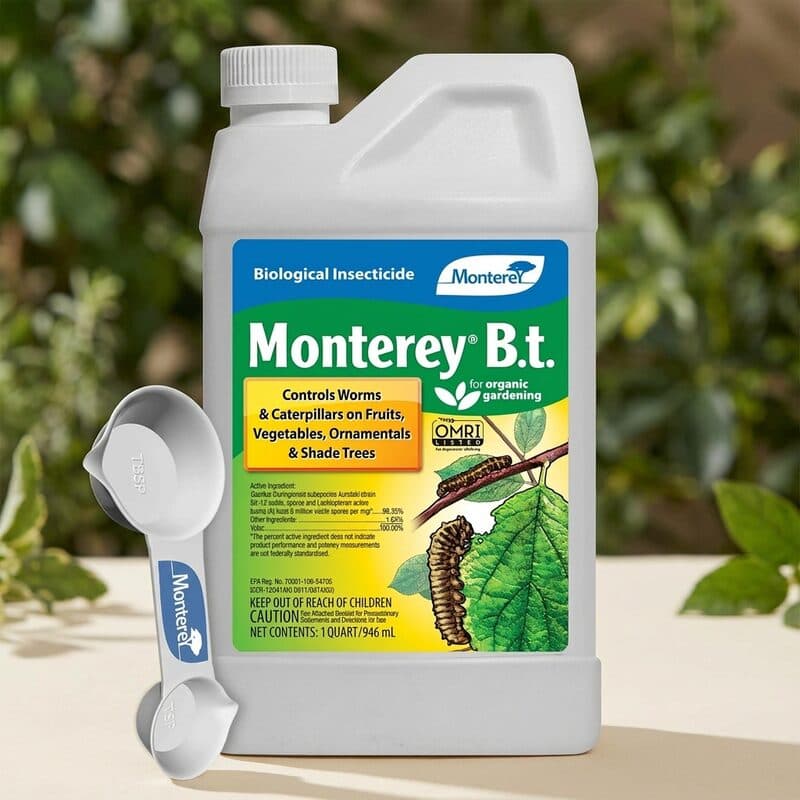
Monterey B.t. Biological Insecticide Concentrate
Best for: Organic vegetable gardeners dealing with cabbage worms, tomato hornworms, cabbage loopers, or other caterpillar damage.
Keep in mind: Active only against caterpillar and worm larvae, not general-purpose
Amazon price as of the checked date, subject to change. The price on Amazon at checkout applies.
Full research
- Active ingredient
- Bacillus thuringiensis subsp. kurstaki (at least 6M viable spores per mg)
- Type
- Biological insecticide, liquid concentrate
- Size
- 32 oz concentrate
- Target pests
- Caterpillars and worm larvae (Lepidoptera)
Monterey B.t. is a liquid concentrate of Bacillus thuringiensis subsp. kurstaki, a naturally occurring soil bacterium that kills caterpillar larvae on contact after ingestion. OMRI listed, it is safe for bees and beneficial insects and can be applied to edible crops up to harvest day.
This catalog-wide research score is separate from this guide's use-case ranking. How we research
Strengths
- Specifically targets caterpillar larvae, with no harm to birds, earthworms, or beneficial insects including bees
- Can be applied right up to harvest day on edible crops
- OMRI listed and one of the most well-established biological insecticides in organic farming
Weaknesses
- Active only against caterpillar and worm larvae, not general-purpose
- Loses potency if stored warm; refrigerate after opening
Sprout Score breakdown
Best for
Organic vegetable gardeners dealing with cabbage worms, tomato hornworms, cabbage loopers, or other caterpillar damage.
Owner rating snapshot
Amazon · 270 reviews · 4.6 stars
Monterey B.t. is a liquid concentrate of Bacillus thuringiensis subspecies kurstaki, a naturally occurring soil bacterium. When caterpillar larvae eat foliage coated in B.t., the spores disrupt their digestive system; feeding stops within minutes and death follows within 2 to 5 days.
The critical advantage over broad-spectrum sprays: B.t. is completely specific to caterpillar and moth larvae. It does nothing to bees, ladybugs, ground beetles, parasitic wasps, or any other beneficial insect. It can be applied to edible crops right up to harvest day. If your problem is cabbage worms, cabbage loopers, imported cabbage worms, or tomato hornworms, B.t. is the answer.
The limitation is exactly that specificity: it will not touch aphids, flea beetles, spider mites, or any non-caterpillar pest. Refrigerate the bottle after opening to preserve the live spore count; potency degrades at warm temperatures.
Best broad-spectrum organic: Captain Jack's Deadbug Brew
Best broad-spectrum organic
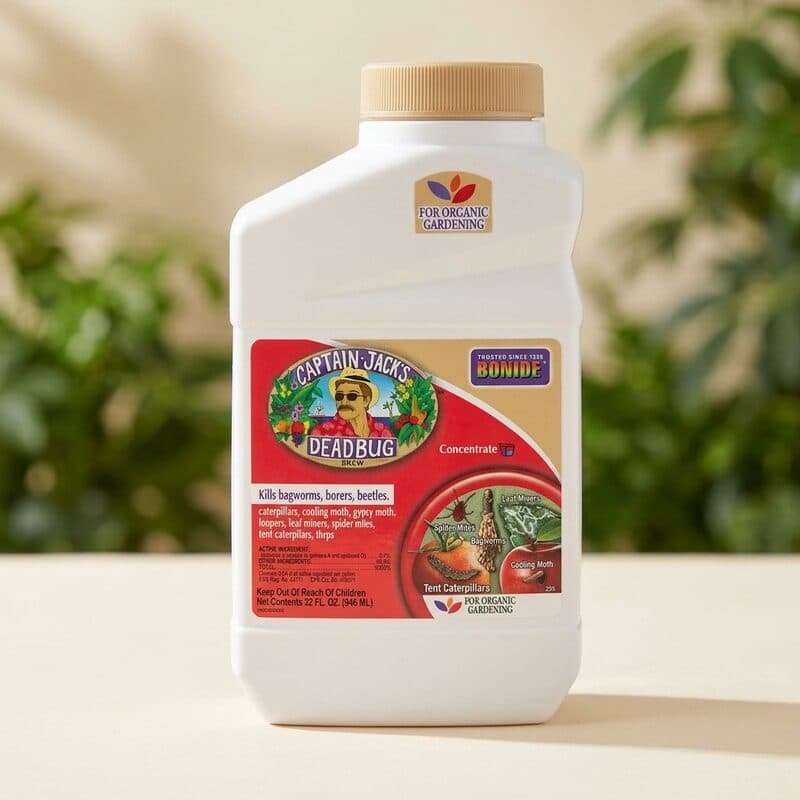
Bonide Captain Jack's Deadbug Brew Concentrate
Best for: Vegetable gardeners who need a single organic spray effective against both caterpillar pests and beetle pests like flea beetles and Colorado potato beetles.
Keep in mind: Can harm bees if applied to open flowers; always apply at dusk and avoid bloom time
Amazon price as of the checked date, subject to change. The price on Amazon at checkout applies.
Full research
- Active ingredient
- Spinosad (spinosyn A + D) 0.5%
- Type
- Biological insecticide, liquid concentrate
- Size
- 16 oz or 32 oz concentrate
- Target pests
- Caterpillars, beetles, flea beetles, thrips, squash bugs, and more
Captain Jack's Deadbug Brew Concentrate uses spinosad (0.5%) derived from the naturally occurring soil bacterium Saccharopolyspora spinosa. OMRI listed, it covers a wide range of chewing insects including caterpillars, flea beetles, Colorado potato beetles, squash bugs, and thrips.
This catalog-wide research score is separate from this guide's use-case ranking. How we research
Strengths
- Spinosad covers a broader pest range than Bt, including beetles and thrips, not only caterpillars
- Derived from a naturally occurring soil bacterium; OMRI listed for organic use
- Highly effective with strong owner track record across vegetable gardens
Weaknesses
- Can harm bees if applied to open flowers; always apply at dusk and avoid bloom time
- 1-day pre-harvest interval (no same-day harvest, unlike Bt)
Sprout Score breakdown
Best for
Vegetable gardeners who need a single organic spray effective against both caterpillar pests and beetle pests like flea beetles and Colorado potato beetles.
Owner rating snapshot
Amazon · 57 reviews · 4.6 stars
Where B.t. stops, spinosad starts. Captain Jack's Deadbug Brew uses spinosad, a fermentation byproduct of the soil bacterium Saccharopolyspora spinosa. It is OMRI listed, highly effective on a wide range of chewing insects, and one of the most recommended organic insecticides among vegetable growers.
Spinosad handles pests B.t. misses: Colorado potato beetles, flea beetles, squash bugs, Japanese beetles, and thrips alongside caterpillars. That breadth makes it the most versatile single spray in this lineup.
The important safety note: spinosad is toxic to bees when wet. Always apply at dusk after pollinators have stopped foraging, and do not spray open flowers directly. The pre-harvest interval is 1 day, so harvest the next morning if needed.
Best for aphids and soft pests: Safer Brand Insect Killing Soap
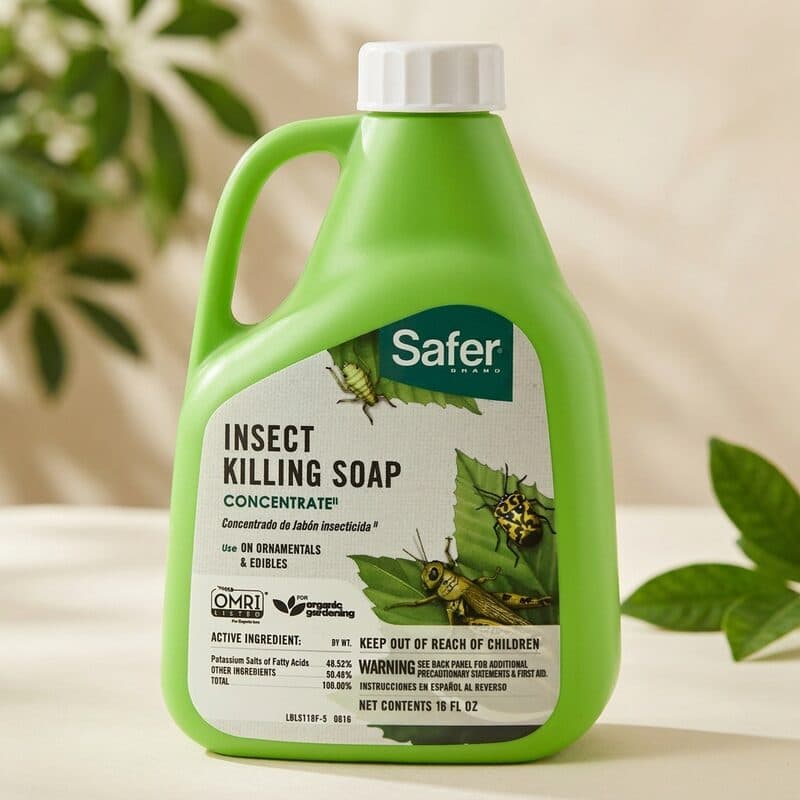
Best for aphids and mites
Safer Brand Insect Killing Soap Concentrate
Best for: Gardeners dealing with aphid colonies, spider mites, or whitefly infestations on vegetables and ornamentals.
Keep in mind: Contact-only; must hit the pest directly, requiring thorough coverage of undersides of leaves
Amazon price as of the checked date, subject to change. The price on Amazon at checkout applies.
Full research
- Active ingredient
- Potassium salts of fatty acids 49.52%
- Type
- Concentrate (mix before use)
- Size
- 16 oz (makes up to 6 gallons)
- Target pests
- Aphids, spider mites, whiteflies, mealybugs, soft scales, thrips
Safer Brand Insect Killing Soap Concentrate uses 49.52% potassium salts of fatty acids to kill soft-bodied insects on contact. OMRI listed, it is one of the safest, most widely used organic insecticides for edible gardens, effective against aphids, spider mites, and whiteflies.
This catalog-wide research score is separate from this guide's use-case ranking. How we research
Strengths
- Kills soft-bodied pests on contact, no systemic residue
- OMRI listed with one of the simplest, safest organic active ingredients
- 16 oz makes up to 6 gallons, low cost per application
Weaknesses
- Contact-only; must hit the pest directly, requiring thorough coverage of undersides of leaves
- Can cause leaf burn if applied in heat or direct sun; spray in the evening
Sprout Score breakdown
Best for
Gardeners dealing with aphid colonies, spider mites, or whitefly infestations on vegetables and ornamentals.
Owner rating snapshot
Amazon · 62 reviews · 4.4 stars
Insecticidal soap is a common treatment for soft-bodied pests. Safer Brand's concentrate contains 49.52% potassium salts of fatty acids, which damage the outer membrane of soft-bodied insects on contact. It works against aphids, spider mites, whiteflies, mealybugs, and soft scales.
The 16 oz concentrate makes up to 6 gallons of finished spray, making the per-application cost one of the lowest in this category. There is no pre-harvest interval.
Two important rules: the spray must hit the insect directly, so thorough coverage of leaf undersides is essential. And soap can cause leaf burn if applied in hot, sunny conditions or on drought-stressed plants. Spray in the evening, and check for phytotoxicity on a small patch first if you have not used it on a particular variety before.
Best three-in-one: Bonide Captain Jack's Neem Oil Concentrate

Best three-in-one
Bonide Captain Jack's Neem Oil Concentrate
Best for: Gardeners who want a single organic spray that addresses insects, mites, and fungal diseases across vegetables, herbs, and flowers.
Keep in mind: Strong sulfur-like odor during mixing and application
Amazon price as of the checked date, subject to change. The price on Amazon at checkout applies.
Full research
- Active ingredient
- Clarified hydrophobic extract of neem oil 70%
- Type
- Concentrate (mix before use)
- Size
- 16 oz (makes multiple gallons)
- Function
- Insecticide, fungicide, miticide
Bonide Captain Jack's Neem Oil Concentrate uses a 70% clarified hydrophobic extract of neem oil to control insects, spider mites, and fungal diseases. OMRI listed, it is one of the most versatile organic sprays for edible and ornamental gardens.
This catalog-wide research score is separate from this guide's use-case ranking. How we research
Strengths
- Three-in-one formula handles pests, mites, and fungal disease in one product
- High 70% active ingredient concentration stretches well as a concentrate
- OMRI listed for use in certified organic production
Weaknesses
- Strong sulfur-like odor during mixing and application
- Must be applied at dusk or dawn to avoid harming pollinators
Sprout Score breakdown
Best for
Gardeners who want a single organic spray that addresses insects, mites, and fungal diseases across vegetables, herbs, and flowers.
Neem oil is the only product in this lineup that addresses insects, mites, and fungal diseases together. Bonide's concentrate contains 70% clarified hydrophobic extract of neem oil. It smothers soft-bodied insects and mites, disrupts the feeding and molting of immature insects, and forms a protective barrier against fungal spores including those that cause powdery mildew and early blight.
Because it works across several pest and disease types, it can reduce the number of separate sprays you need. It is especially useful on tomatoes, where fungal disease and mites may appear together in midsummer.
Like spinosad, neem oil can harm bees if they contact wet spray. Apply at dusk. Avoid spraying plants that are heat- or drought-stressed, as the oil can cause leaf burn in those conditions.
Best for slugs: Monterey Sluggo
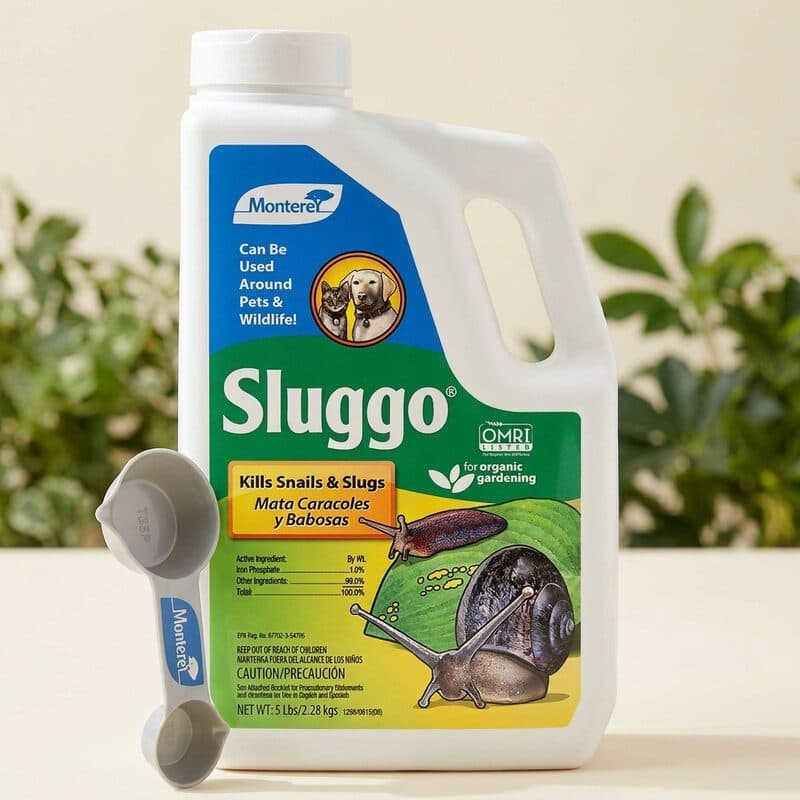
Alternative Granular slug bait
Monterey Sluggo Slug and Snail Killer
Best for: Vegetable and flower gardeners in moist climates who need a pet-safe, OMRI-listed slug control that holds up through rain and irrigation.
Keep in mind: Targets only slugs and snails, not other insects
Amazon price as of the checked date, subject to change. The price on Amazon at checkout applies.
Full research
- Active ingredient
- Iron phosphate 1%
- Type
- Granular bait
- Size
- 1 lb, 2.5 lb, and larger bags
- Target pests
- Slugs and snails
Monterey Sluggo uses 1% iron phosphate granules to kill slugs and snails. OMRI listed and safe around pets and wildlife, it remains effective after rain and breaks down into iron and phosphate in the soil. It is one of the most widely trusted organic slug baits.
This catalog-wide research score is separate from this guide's use-case ranking. How we research
Strengths
- Iron phosphate is safe around pets, wildlife, and children, unlike metaldehyde baits
- Granules remain effective after rain, unlike many older bait formulations
- OMRI listed; iron phosphate breaks down into naturally occurring soil nutrients
Weaknesses
- Targets only slugs and snails, not other insects
- Must be scattered around plants before damage occurs; reactive application is less effective
Sprout Score breakdown
Best for
Vegetable and flower gardeners in moist climates who need a pet-safe, OMRI-listed slug control that holds up through rain and irrigation.
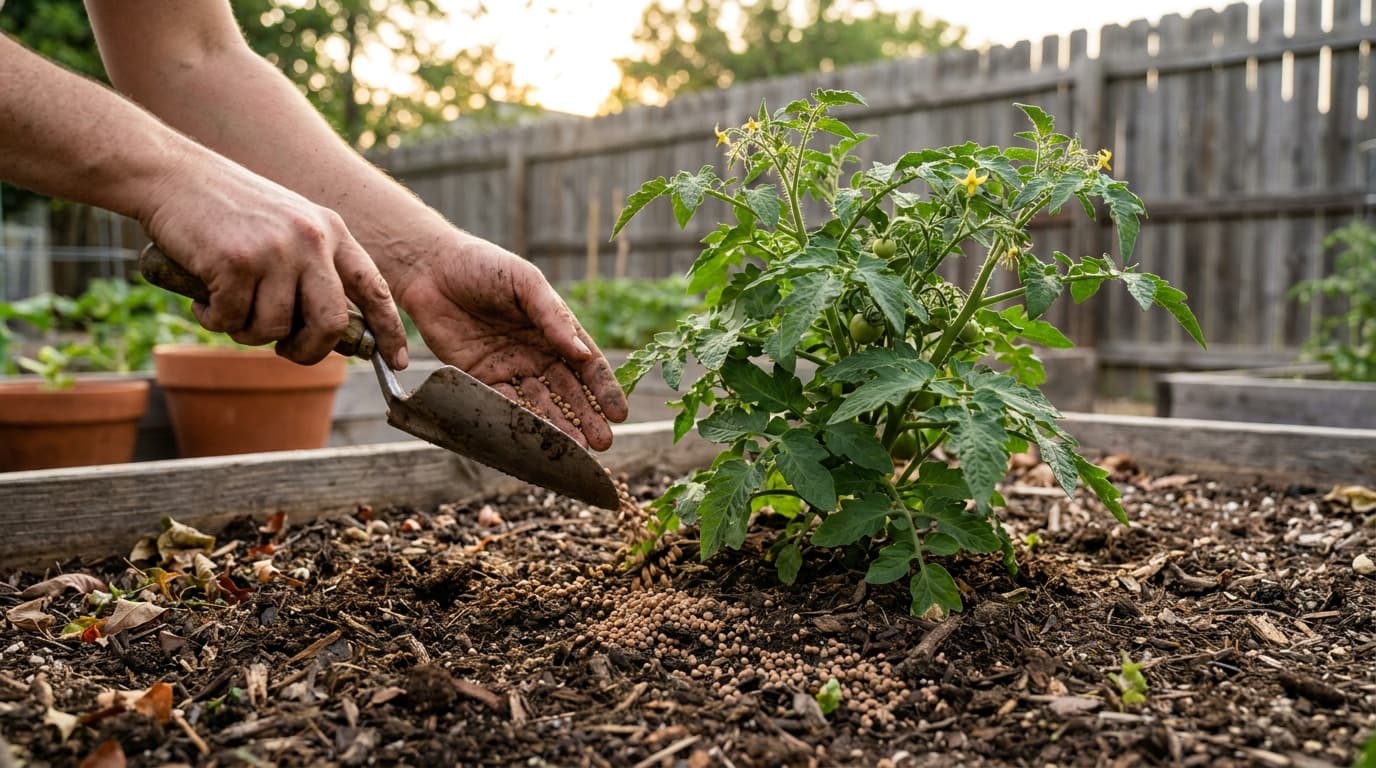
Sluggo uses a fundamentally different approach from the sprays above: it is a granular bait, not a foliar spray. Its active ingredient is iron phosphate (1%), which slugs and snails consume when they encounter the pellets. They stop feeding and die within 3 to 6 days. Iron phosphate then breaks down into naturally occurring iron and phosphate in the soil.
Sluggo is OMRI listed, safe around pets and wildlife, and the granules hold up after rain, which distinguishes it from older metaldehyde baits. Scatter it around vulnerable transplants, along bed edges, and in areas where slugs shelter during the day. If your beds are showing the characteristic silvery slime trails and ragged holes overnight, scatter Sluggo before planting seedlings, not after the damage is done. See our full slug control guide for timing and cultural tactics.
How to choose the right spray
Match pest to product. This is the most important rule. Spraying a contact insecticide on caterpillar eggs, or applying Bt to an aphid colony, wastes product and time. Identify the pest first, then choose.
Apply at dusk, every time. Sprays that contact foraging bees cause harm regardless of how natural the active ingredient is. Dusk application gives the spray time to dry before bees return in the morning. This applies to spinosad, neem oil, and insecticidal soap.
Follow the product label. Every label specifies mix rate, application interval, and pre-harvest interval. Doubling the concentration does not improve efficacy and can damage plants. Applying too frequently can drive resistance in pest populations and harm soil and foliar biology.
Never spray stressed plants with oil or soap. Plants under heat or drought stress have compromised cuticles and are far more prone to phytotoxic damage from oil- and soap-based sprays. Water the day before application and choose a cool part of the evening.
Start with the least-disruptive option. If aphids can be knocked off with a strong stream of water, do that first. Reserve spinosad and neem oil for infestations that cultural controls cannot resolve. Using broad-spectrum organics routinely disrupts the beneficial insect populations (parasitic wasps, predatory beetles) that provide natural pest suppression for free. See organic pest control basics for the full framework.
| Product | Price | Best for | Buy |
|---|---|---|---|
| Monterey B.t. Biological Insecticide Concentrate#1 · BEST FOR CATERPILLARS | Typical price range · Under $25 | Organic vegetable gardeners dealing with cabbage worms, tomato hornworms, cabbage loopers, or other caterpillar damage. | Shop Amazon |
| Bonide Captain Jack's Deadbug Brew Concentrate#2 · BEST BROAD-SPECTRUM ORGANIC | Typical price range · Under $25 | Vegetable gardeners who need a single organic spray effective against both caterpillar pests and beetle pests like flea beetles and Colorado potato beetles. | Shop Amazon |
| Safer Brand Insect Killing Soap Concentrate#3 · BEST FOR APHIDS AND MITES | Typical price range · Under $25 | Gardeners dealing with aphid colonies, spider mites, or whitefly infestations on vegetables and ornamentals. | Shop Amazon |
| Bonide Captain Jack's Neem Oil Concentrate#4 · BEST THREE-IN-ONE | Typical price range · Under $25 | Gardeners who want a single organic spray that addresses insects, mites, and fungal diseases across vegetables, herbs, and flowers. | Shop Amazon |
| Monterey Sluggo Slug and Snail KillerAlternative · GRANULAR SLUG BAIT | Typical price range · Under $25 | Vegetable and flower gardeners in moist climates who need a pet-safe, OMRI-listed slug control that holds up through rain and irrigation. | Search Amazon |
What is the safest organic spray for vegetable gardens?
Monterey B.t. has the narrowest target range (caterpillar larvae only) and is the safest option for beneficial insects. Safer Brand insecticidal soap and Monterey Sluggo are also very low risk to non-target insects. Spinosad and neem oil are OMRI listed but should be applied only at dusk and kept off open flowers, as both can harm bees when wet.
Can I use spinosad and neem oil together?
You can rotate them in an integrated program, but applying them together in the same tank is generally not recommended; mixing formulations can reduce efficacy or cause leaf burn. Use each according to its label, and keep a rotation to reduce the chance of resistance developing in pest populations.
How long before harvest can I spray organic insecticides?
Bt (Monterey B.t.) and insecticidal soap (Safer Brand) have a zero-day pre-harvest interval, meaning you can harvest the same day. Captain Jack's Deadbug Brew (spinosad) has a 1-day interval. Neem oil labels vary by formulation; always check the specific product label for the pre-harvest interval before applying near harvest time.
Does neem oil kill beneficial insects?
Neem oil can harm soft-bodied beneficial insects (including predatory mite larvae and small parasitic wasps) if they are directly sprayed while the product is wet. Applying at dusk significantly reduces this risk. Bt and Sluggo have essentially no impact on beneficial insects.
Why are the slugs eating my seedlings but I don't see them?
Slugs feed at night and hide during the day under mulch, debris, boards, or in soil cracks. If you are seeing irregular holes in leaves and silvery slime trails but no visible pest during the day, slugs are the likely culprit. Scatter Monterey Sluggo granules around transplants in the evening and check the next morning. See the full slug management guide for cultural controls that reduce habitat.
Building a short rotation of targeted organic sprays covers nearly every common vegetable pest without disrupting soil and beneficial insect biology. Match the product to the pest, always apply at dusk, follow the label rate, and pair any spray program with the cultural controls in our organic pest control basics guide. Check your planting calendar to time applications around key pest pressure windows in your zone.