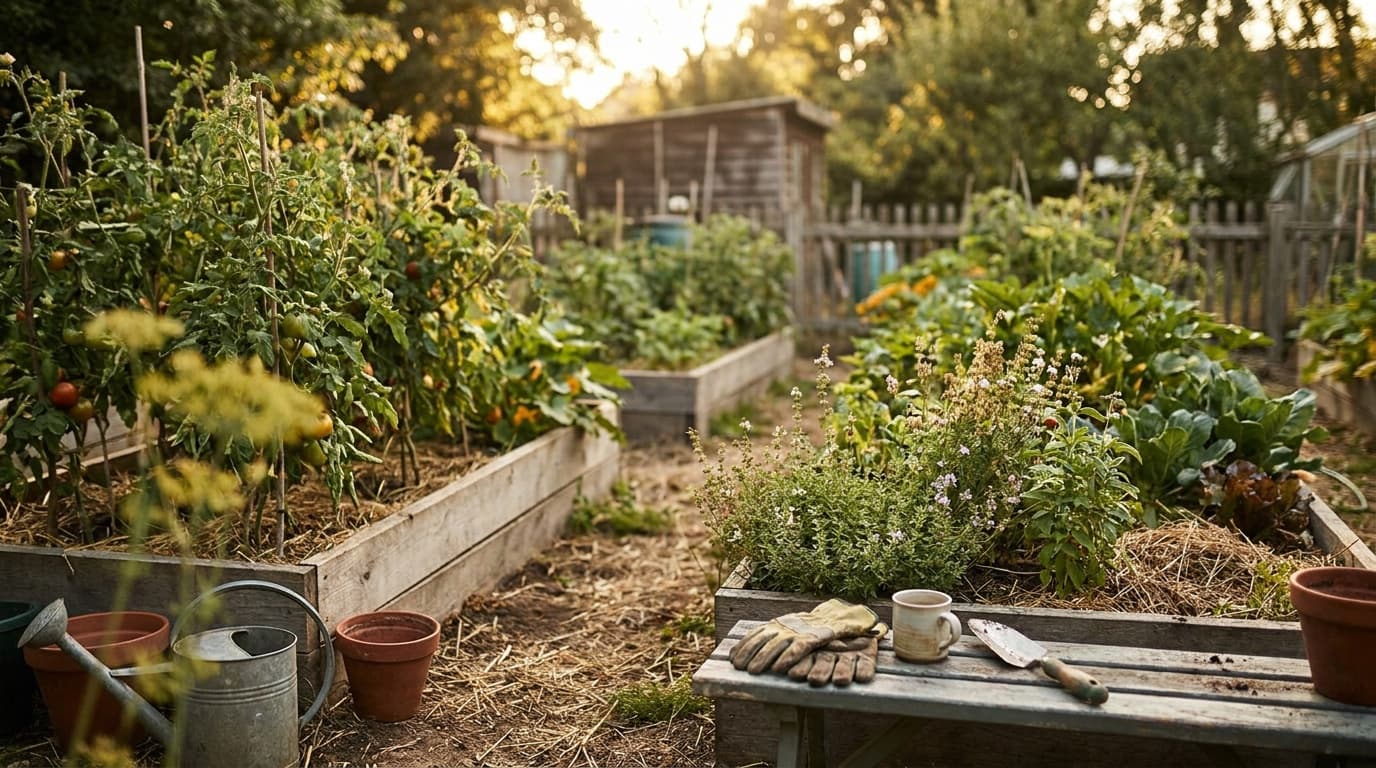
Companion planting is one of the most over-promised ideas in gardening. The classic chart, the one circulated as a grid of "friends" and "enemies," mixes a few evidence-backed relationships with a great deal of inherited folklore. Some of it traces to a single mid-century book whose claims were never tested. So before you rearrange your beds around which plants supposedly "love" each other, it is worth separating the mechanisms that demonstrably work from the ones that are simply repeated.
The good news: the real mechanisms are intuitive, and you can act on them today.
The four mechanisms that actually do something
Strip away the mysticism and beneficial plant pairings work through one of four physical or biological pathways.
Why companion planting works (when it does)
Physical structure
Pollinator and predator draw
Trap cropping
Ground cover and spacing
Notice what is not on the list: claims that one plant chemically improves another's flavor, or that certain plants "repel" pests through scent in any reliable, measurable way. Those are the claims with the weakest support.
Pairings with real support
These are the combinations that work because of the four mechanisms above, not because of folklore.
Tall and short: corn, beans, and squash
The "Three Sisters" is the best-documented companion system there is, and it works for structural reasons. Sweet corn provides a living trellis for pole beans; the beans fix nitrogen in the soil; and sprawling winter squash or pumpkin shades the ground, suppressing weeds and holding moisture. Each plant occupies a different layer.
Flowers among vegetables: drawing in the good bugs
Interplanting flowering plants among your vegetables increases beneficial insect activity. Bees improve fruit set on crops like squash, cucumber, and tomatoes, while plants in the carrot and aster families (dill, cilantro, alyssum, zinnias) attract tiny predatory wasps and hoverflies whose larvae devour aphids.
Trap crops: the willing sacrifice
A trap crop is a plant pests prefer over your main crop, planted to lure them away. Nasturtiums draw aphids; blue Hubbard squash pulls squash bugs and cucumber beetles off your zucchini and cucumbers. The catch: a trap crop only helps if you then deal with the concentrated pests (remove them, treat them, or pull the trap plant), otherwise you have just built a pest nursery.
Living mulch: shading the soil
Low, dense plantings shade bare soil, which suppresses weeds and slows evaporation. Letting lettuce or a low herb fill the gaps between taller crops is a mild version of this. It is the same principle behind mulching, just done with living plants.
The pairings to ignore (and the one rule that matters more)
Skip any chart entry that promises flavor improvement, generic "repelling," or vague "good energy." There is no reliable evidence basil changes how a tomato tastes, and the supposed enemy pairings (do not plant X near Y) rarely hold up.
The rule that matters far more than any pairing is spacing. Crowding plants, companion or not, creates competition for light and water and the stagnant, humid air that breeds disease like powdery mildew and downy mildew. A "perfect" companion pair planted too close together will do worse than two unrelated crops given room.
Before you finalize any interplanting scheme, run your bed and crop list through the spacing calculator so good intentions do not turn into a crowded, disease-prone tangle.
Time your interplanting to the calendar
Companion planting only works if both partners are in the ground at compatible times. Cool-season flowers and crops go in early; warm-season partners wait until after frost. Use the planting calendar for your ZIP to line up sow and transplant dates, and confirm your window with the frost dates tool so an early planting of one partner does not get frosted while you wait on the other.
Does companion planting really work?
Some of it does, through clear physical and biological mechanisms: tall plants supporting or shading short ones, flowers attracting pollinators and predatory insects, trap crops luring pests away, and ground cover suppressing weeds. The mystical claims (flavor improvement, scent-based repelling) have little to no reliable evidence. Use the mechanism-based pairings and treat the rest of the traditional chart with skepticism.
What should not be planted together?
The genuine conflicts are about resources and disease, not personality. Do not crowd heavy feeders together if your soil is poor, and avoid planting crops from the same family (tomatoes, peppers, potatoes, eggplant) in a tight block year after year, which concentrates shared pests and diseases (see crop rotation for home gardens). Most "enemy" pairings from old charts do not hold up; spacing matters far more than the supposed antagonisms.
Do marigolds keep pests away?
Partly, and the detail matters. French marigolds can suppress root-knot nematodes in soil, but mainly when grown densely as a cover crop and tilled in, not from a few flowers scattered among vegetables. As a border, marigolds are useful chiefly for drawing in pollinators and predatory insects. The popular belief that they repel flying pests from neighbors is much weaker than commonly claimed.
What is the Three Sisters method?
It is the corn, beans, and squash planting used by many Indigenous North American farmers, and the best-documented companion system there is. Corn provides a trellis for climbing beans, beans fix nitrogen that feeds the corn and squash, and sprawling squash shades the soil to suppress weeds and hold moisture. Each crop occupies a different vertical and horizontal layer, so they cooperate rather than compete.
Companion planting is worth doing once you treat it as ecology rather than folklore. Use the four real mechanisms, give everything proper spacing, and ignore the charts that promise magic. For the bigger picture of arranging crops over time as well as space, read crop rotation for home gardens.