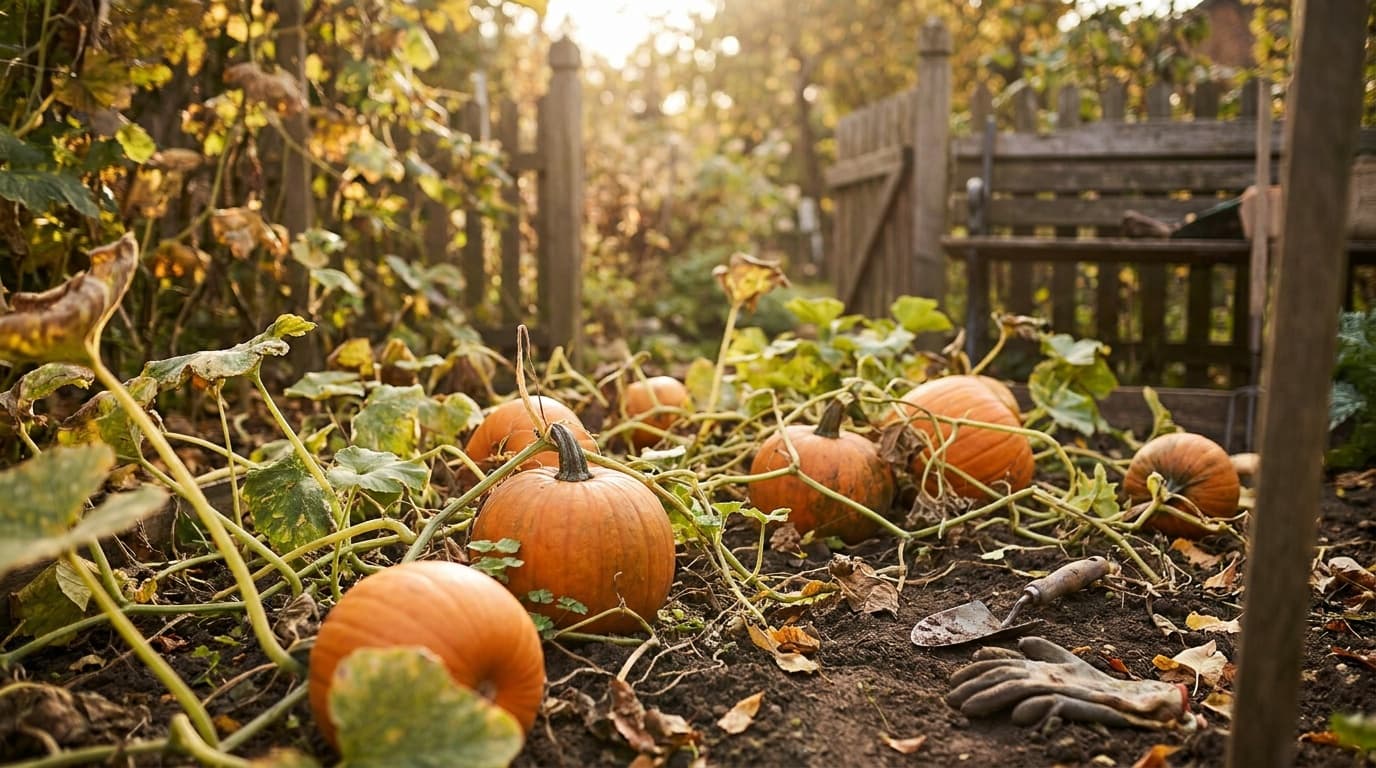
Pumpkins need ample space, a long growing season, steady water, and fertile soil. Plan the vine path and support pollinators whether you are growing carving pumpkins, pie varieties, or display fruit.
Direct sowing vs. transplanting: Direct sowing avoids root disturbance. An indoor start can help a short season, but use individual pots and transplant the root ball intact. See how to start seeds indoors for the technique.
Site and soil
Growth habit: Standard vining pumpkins can travel well beyond the crown. If the garden cannot absorb that spread, look for compact or bush varieties and plan a clear route over mulch, a path edge, or unused ground. Use the pumpkin profile for the bed layout.
Light: Use the brightest open site available and avoid placing vines where taller crops will shade them.
Soil: Pumpkins are heavy feeders and do best in deep, fertile, well-drained soil with good organic matter. Work mature compost through the root area before planting.
Drainage: critical. Pumpkins planted in low spots or heavy clay are prone to root and stem rot, and standing water during the growing season causes rapid plant decline.
Raised beds are a strong choice for pumpkins in heavy soil, allowing vines to run out over the surrounding ground while roots stay in well-draining, enriched soil.
Planting method
Planting pumpkins
Prepare the site
Sow or transplant
Set the vine direction
Water in well
Mulch the base
Watering and feeding
Pumpkins need consistent, deep watering at the crown and along rooted vine nodes. Use the moisture guidance on the pumpkin profile as the baseline, then adjust for rain, heat, and soil texture. Let the surface dry slightly between waterings to reduce fungal pressure.
Do not water overhead once vines are running. Wet foliage in warm, humid conditions is the setup for powdery mildew and downy mildew. A soaker hose laid along the vine base before vines sprawl is one of the most effective long-term setups.
Fertilizer: pumpkins are heavy feeders across a long growing season. A balanced organic fertilizer incorporated at planting sets a good foundation. Then:
- Fertilize with nitrogen-forward fertilizer as vines begin running, to support vigorous leaf and stem growth.
- Shift toward a lower-nitrogen, higher-phosphorus/potassium fertilizer once fruit has set, to support fruit development rather than continued vine growth.
Some links on this page are affiliate links. As an Amazon Associate I earn from qualifying purchases.
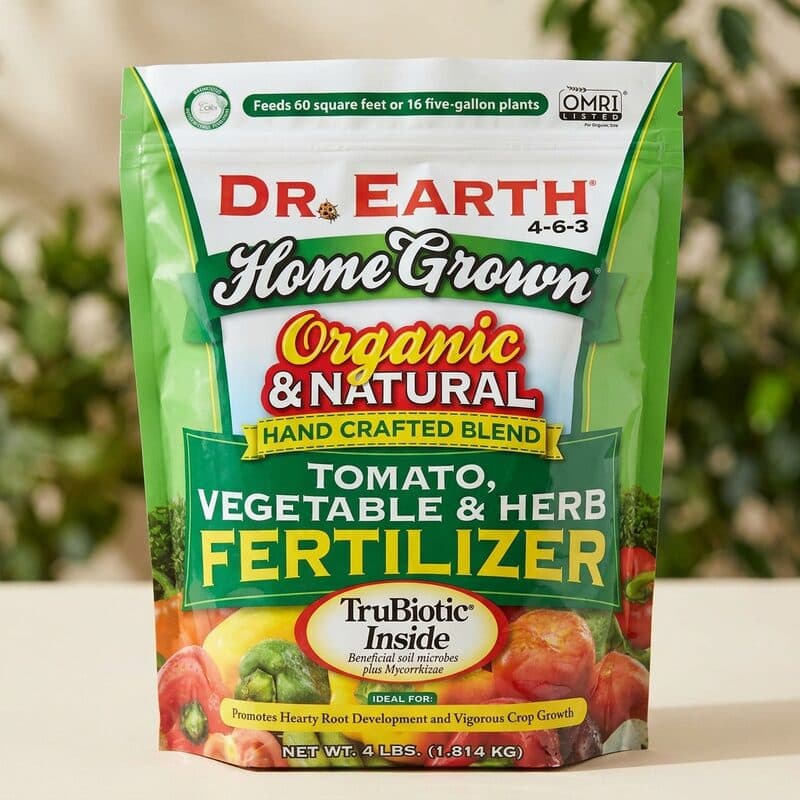
Vegetable fertilizer
Dr. Earth Home Grown Tomato, Vegetable & Herb Fertilizer
Best for: Organic growers feeding tomatoes, vegetables, and herbs through the season.
Keep in mind: Earthy organic smell on application
Amazon price as of the checked date, subject to change. The price on Amazon at checkout applies.
Full research
- NPK
- 4-6-3
- Type
- Granular organic
- Microbes
- Probiotic soil microbes + mycorrhizae
- Use
- Tomatoes, vegetables, and herbs
A hand-crafted organic fertilizer for tomatoes, vegetables, and herbs, fortified with probiotic soil microbes and mycorrhizae to support root and soil health on edible crops.
This catalog-wide research score is separate from this guide's use-case ranking. How we research
Strengths
- Probiotic microbes and mycorrhizae support soil life
- Balanced profile tuned for edible crops
- Non-GMO, OMRI-listed inputs
Weaknesses
- Earthy organic smell on application
- Granular feeds act more slowly than synthetics
Sprout Score breakdown
Best for
Organic growers feeding tomatoes, vegetables, and herbs through the season.
Owner rating snapshot
Amazon · 82 reviews · 4.6 stars
Vine management
Once pumpkins start running, their vines will go wherever they want unless you guide them. This matters for a few reasons: unmanaged vines wander into paths, crowd other plants, and make it hard to water and tend the bed efficiently.
Managing vines
Direct early growth
Bury secondary vine nodes
Remove secondary vines if space is tight
Limit fruit per vine
Pollination
Pumpkins are insect-pollinated, primarily by bees. They produce separate male and female flowers on the same plant. Male flowers appear first, often 1 to 2 weeks before female flowers. Female flowers are identifiable by the small proto-fruit (a tiny pumpkin shape) at the base of the flower; male flowers have a plain stem.
For fruit to set, pollen must be transferred from a male to a female flower by a pollinating insect while both are open. Flowers are open for only one morning each.
If fruit sets then shrivels and drops: poor pollination is the most common cause. See poor pollination. Solutions:
- Avoid applying pesticides during flowering, especially in the morning when bees are active and flowers are open. Even low-toxicity pesticides kill bees when applied directly.
- If bee activity is low, hand-pollinate: use a small paintbrush or snap off a male flower, peel back its petals, and dab its pollen-covered center against the center of an open female flower.
Common problems
- Squash bug: gray-brown insects and clusters of bronze eggs on leaf undersides. Nymphs and adults suck plant sap, causing wilting. Remove eggs by hand; insecticidal soap on nymphs.
- Squash vine borer: sudden wilting of vines, sawdust-like frass at the vine base. Larva of a clearwing moth tunneling inside the stem. Difficult to treat; row cover before adult moths fly (late June/July in most regions) is the primary prevention.
- Powdery mildew: white powdery coating on older leaves, most common in late season. Rarely kills the plant before harvest if vines are otherwise healthy; manage airflow and avoid overhead watering.
- Striped cucumber beetle and spotted cucumber beetle: feeding damage on leaves and potential vectors of bacterial wilt, which causes sudden, permanent vine collapse. Row cover during establishment, remove when flowering starts.
- Poor pollination: fruit sets then rots or drops. Protect pollinators; hand-pollinate if necessary.
- Downy mildew: yellow angular patches on upper leaf surface. Avoid overhead watering.
Harvesting
Knowing when a pumpkin is ready matters more than the calendar. Do not harvest by date alone; use these checks:
Harvest readiness indicators
Rind hardness
Stem condition
Color
Vine condition
To harvest: cut the stem with clean pruners or a sharp knife, leaving 3 to 4 inches of stem attached. A pumpkin without its stem rots much faster. Carry by cradling the base, never by the stem, which can snap and shorten storage life dramatically.
Curing: cure pumpkins for about 10 days at 80 to 85°F and 75 to 80 percent relative humidity with good air circulation. Curing hardens the rind and helps minor surface wounds heal. After curing, store at 50 to 55°F with good ventilation; sound pumpkins can keep for eight weeks or more under those conditions.
How do I keep pumpkin vines out of paths?
Redirect young, flexible vines a little at a time and pin them gently with a loose landscape staple if needed. Do not twist mature vines or drag fruiting sections. A compact variety is the better answer when the garden has no safe route for a standard vine.
Why are my pumpkin flowers not producing fruit?
The most common cause is poor pollination. Male flowers open first, about 1 to 2 weeks before female flowers appear; early male flowers will all drop without producing fruit, which is normal. Once both male and female flowers are open simultaneously, fruit can set only if bees (or hand pollination) transfer pollen. If bees are absent or if pesticides were applied during morning flowering hours, female flowers will abort. See poor pollination.
How do I know when a pumpkin is ready to harvest?
Use three checks together: the rind resists puncture by a thumbnail, the stem is dry and corky rather than green and pliable, and the fruit has reached its full mature color. Do not rely on days-to-maturity as the sole indicator, since growing conditions affect timing significantly. Early frost is the only valid reason to harvest slightly early; an immature pumpkin will not ripen off the vine the way a tomato does.
Can I grow pumpkins vertically?
Small varieties (under 5 pounds) can be grown vertically on a sturdy trellis, with the fruit supported in a net sling as it develops. Standard carving pumpkins (10 to 20 pounds) and large varieties are too heavy for vertical growing in most home setups. See vertical gardening vegetables for what works on a trellis.
What makes pumpkins keep well in storage?
Properly cured pumpkins stored at 50 to 55°F with good ventilation can keep for eight weeks or more. Carved or cut pumpkins deteriorate quickly regardless of storage conditions. Cure sound fruit, protect the rind from damage, and check stored pumpkins periodically for soft spots.
Give pumpkins a clear vine path, consistent nutrients and water, and access to pollinators. Use the profile for dates and measurements. Before harvest, check the rind, stem, color, and vine condition, then cure each sound fruit.