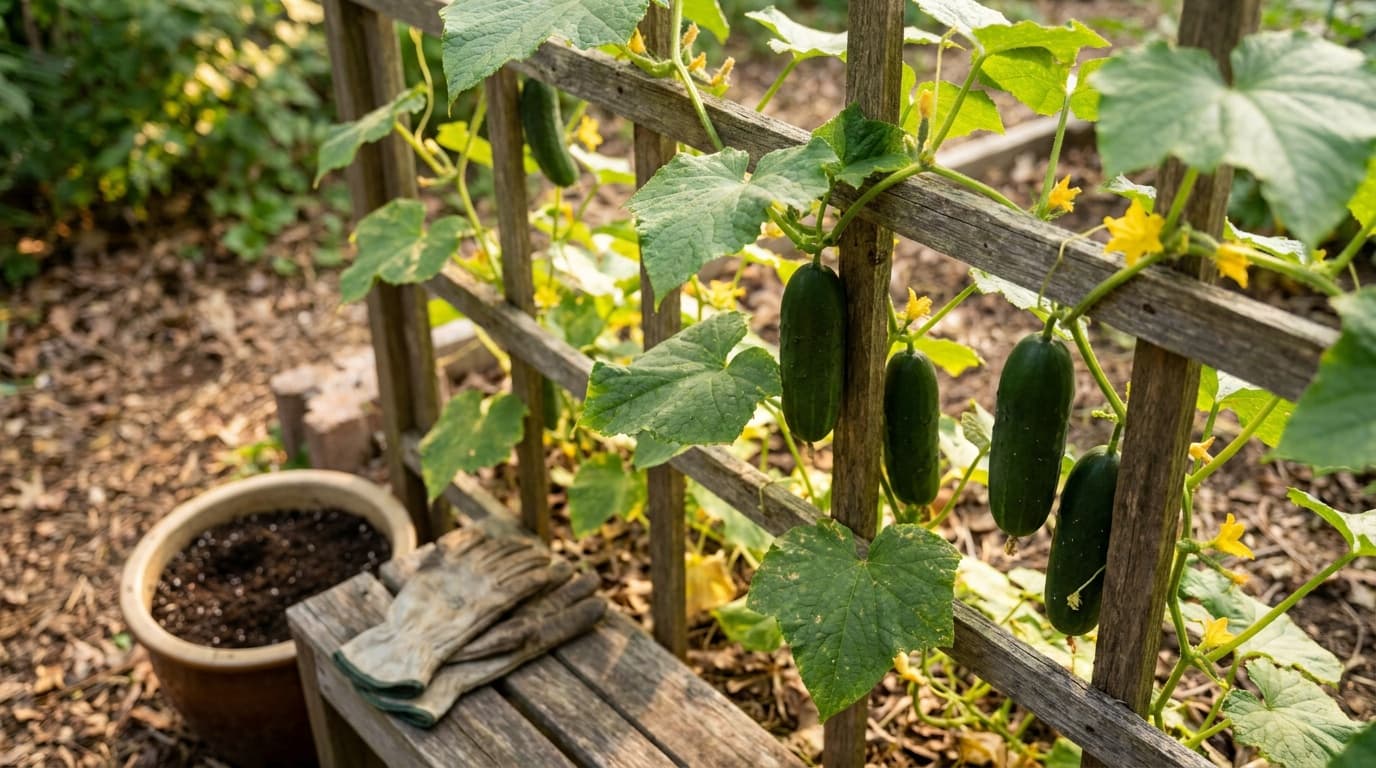
Cucumbers are fast-growing vines with a generous harvest when the plants stay hydrated and pollinated. Their most consequential early threat is the striped cucumber beetle, which feeds on seedlings and can spread bacterial wilt before vines have a chance to establish.
Prepare a trellised or ground-growing bed
Choose a bright, well-drained bed with room for a trellis or a clearly defined vine path. The cucumber profile carries the exact light and soil targets.
Cucumbers benefit from compost worked through loose soil before planting. Poor drainage leads to root stress and stunted growth. If your soil is heavy clay, a raised bed with amended soil is a practical advantage. See our raised bed gardening guide for how to set one up.
Choose ground growth or a trellis
Cucumbers are vines. You can grow them on the ground in hills or up a trellis, and both methods work. Vertical growing saves space, improves airflow, and makes harvesting easier.
Two ways to grow cucumbers
On a trellis
On the ground
Vertical growing pairs naturally with trellises in raised beds and is covered in more depth in our vertical gardening guide.
Watering and feeding
Cucumbers hold a great deal of water in their fruit, and inconsistent irrigation shows quickly in quality. Deliver water at the base rather than overhead. Wet foliage favors powdery mildew and downy mildew. Use the weekly baseline on the cucumber profile, then adjust for rainfall and how quickly your soil drains.
Inconsistent moisture (deep drought followed by heavy watering) causes bitter flavor in the fruit and can contribute to poor fruit set.
A drip irrigation kit or soaker hose makes consistent cucumber watering much easier to maintain across dry spells.
Some links on this page are affiliate links. As an Amazon Associate I earn from qualifying purchases.

Consistent cucumber watering
Raindrip Automatic Watering Kit with Timer (R560DP)
Best for: Container and patio gardeners who want automatic watering with minimal setup.
Keep in mind: Plastic fittings are less rugged than premium components
Amazon price as of the checked date, subject to change. The price on Amazon at checkout applies.
Full research
- Type
- Container and patio drip kit
- Timer
- Battery-powered automatic timer included
- Tubing
- 1/4 in and 1/2 in poly tubing
- Connection
- Standard hose faucet
Raindrip's automatic kit bundles a faucet timer, tubing, and emitters into a beginner-friendly drip system for containers and small plantings.
This catalog-wide research score is separate from this guide's use-case ranking. How we research
Strengths
- Includes a timer, so it automates watering out of the box
- Beginner-friendly assembly with no special tools
- Inexpensive way to test drip irrigation
Weaknesses
- Plastic fittings are less rugged than premium components
- Coverage suits containers and small areas, not large beds
Sprout Score breakdown
Best for
Container and patio gardeners who want automatic watering with minimal setup.
Feeding: Work compost into the bed before planting. Side-dress with a balanced granular fertilizer once plants begin to vine (after the first 3 to 4 true leaves appear). Avoid excess nitrogen, which pushes leafy growth and can reduce fruit set. An all-purpose organic fertilizer applied every 3 to 4 weeks through the season covers cucumber feeding needs.
Pollination and fruit set
Cucumber plants produce separate male and female flowers on the same plant. Male flowers open first, sometimes a week or more before female flowers appear. Female flowers have a small embryonic fruit (a tiny cucumber) at the base of the petals; male flowers do not.
For fruit to develop, pollen must be transferred from male to female flowers, almost always by bees. Poor pollination causes fruit that is narrow at the blossom end, misshapen, or that drops off entirely.
Note on row cover timing: If you use floating row cover to exclude cucumber beetles, you must remove it once flowers open so that bees can access the blossoms. A covered cucumber plant with no bee access will produce no fruit.
Common problems to watch for
Pests:
- Striped cucumber beetle: Yellow-and-black striped beetles that feed on leaves and stems from emergence onward. Their most serious impact is vectoring bacterial wilt, a fatal disease that cannot be cured. Even a small number of feeding beetles can transmit the pathogen (Erwinia tracheiphila). Row cover early in the season is the most effective home-garden defense. Some varieties such as 'County Fair F1' and 'Little Leaf H-19' have partial resistance to bacterial wilt.
- Spotted cucumber beetle: Similar to the striped version in impact; less common but also vectors bacterial wilt. Management is the same.
Diseases:
- Bacterial wilt: Causes rapid, progressive wilting that does not recover overnight. Transmitted by cucumber beetles; once inside the plant it is fatal. No cure, prevention is the only strategy. Pull and discard wilted plants immediately to prevent beetle spread.
- Powdery mildew: White powdery coating on leaves, common in mid to late season as conditions dry and nights cool. Choose resistant varieties; improve airflow; avoid overhead watering.
- Downy mildew: Angular yellow patches on upper leaf surfaces with gray-purple fuzz on the undersides. Spreads in humid, wet conditions. Remove affected foliage; improve spacing and airflow.
- Anthracnose: Round, water-soaked spots on leaves and fruit that turn tan or dark. Avoid overhead watering and rotate crops annually.
Harvesting cucumbers
Most slicing cucumbers are ready to harvest when they reach 6 to 8 inches long and are uniformly dark green from stem to blossom end. Pickling types are typically harvested at 2 to 4 inches.
Do not let cucumbers stay on the vine too long. An overripe cucumber turns yellow, becomes seedy and bitter, and signals the plant to slow down production. Harvest every 2 to 3 days once the season is underway. Frequent picking keeps the plant productive.
Cut the stem with scissors or pruners rather than pulling, which can damage the vine.
Succession sowing
Because cucumbers have a finite productive period before disease and heat end the season, a second sowing 3 to 4 weeks after the first extends your harvest window. See our succession planting guide for how to sequence plantings effectively.
For related crops, zucchini shares a similar warm-soil requirement and pollination profile. Green beans are another fast-maturing warm-season crop worth pairing with cucumbers in season planning.
Should cucumbers grow on a trellis or on the ground?
A trellis saves space, improves airflow, and makes fruit easier to find. Ground growth works when you have a broad mulched area and want minimal training. Choose before sowing so the support is in place before vines begin to run.
Why do cucumbers turn bitter?
Moisture stress, heat, and fruit left on the vine too long can all intensify bitterness. Keep the root zone evenly moist, mulch the bed, and harvest promptly. A consistently bitter variety may simply be a poor fit for your summer conditions.
Why are my cucumber flowers not turning into cucumbers?
The most common cause is poor pollination. Cucumber flowers need bees to transfer pollen from male to female flowers. If bee activity is low, or if you have the plants under row cover, fruit set will be poor. Remove row cover once flowers open, and hand-pollinate on days with no bee activity. See our poor pollination guide for diagnosis and technique.
What is the white powder on my cucumber leaves?
That is powdery mildew, a fungal disease common in mid to late season as nights cool and humidity rises. It rarely kills plants but reduces yield and vigor. Improve airflow, avoid overhead watering, remove the most affected leaves, and consider mildew-resistant varieties for next season.
How do I know when cucumbers are ready to pick?
Most slicing cucumbers are ready at 6 to 8 inches long with uniformly dark green skin. Harvest before any yellowing begins; a yellow cucumber is overripe, seedy, and bitter. Check every 2 to 3 days once the season starts. Frequent harvesting keeps the plant producing.