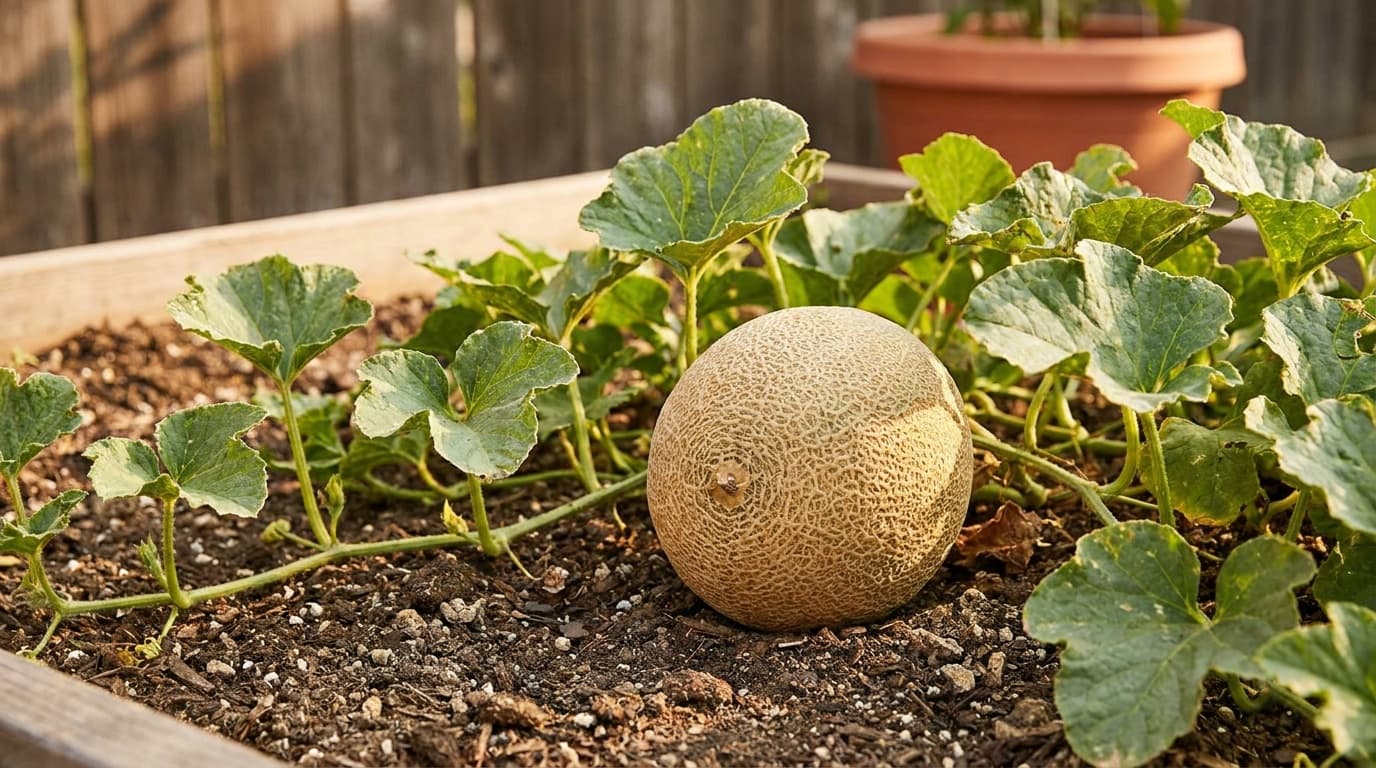
Cantaloupe is a melon that's slightly more forgiving than watermelon when it comes to season length, but it shares the same core needs: heat, space, good drainage, and reliable bee activity. Get those right and cantaloupe is one of the more satisfying summer crops to grow.
For short-season gardens, starting transplants indoors can add useful growing time. See how to start seeds indoors for the full setup and how to harden off seedlings before moving plants outside. Cantaloupe roots dislike disturbance, so sow in individual pots rather than open trays.
If your growing season is borderline, pairing transplants with black plastic mulch to warm the soil is a widely used extension-recommended technique.
Site and soil
Cantaloupe wants:
- The brightest open site available
- Well-drained soil; poorly drained soil causes root problems and vine collapse
- Warm soil temperature maintained through the season
The cantaloupe profile carries the exact light and soil targets.
Sandy loam soils that warm quickly and drain well are ideal. Clay soils benefit from generous compost incorporation and raised planting. Raised beds offer consistent drainage and can be warmed earlier in spring.
Some links on this page are affiliate links. As an Amazon Associate I earn from qualifying purchases.

Well-drained melon bed
Greenes Fence Cedar Raised Garden Bed
Best for: Gardeners who want a natural, untreated wood bed and accept periodic replacement.
Keep in mind: Wood breaks down faster than metal over years
Amazon price as of the checked date, subject to change. The price on Amazon at checkout applies.
Full research
- Material
- Untreated cedar
- Assembly
- Dovetail interlocking boards
- Expandable
- Stackable and expandable
- Sourcing
- North American cedar
Greenes Fence makes the best-known cedar raised bed, using a no-hardware dovetail system that lets you stack tiers or expand the footprint. Untreated cedar is naturally rot-resistant but will gray and eventually break down outdoors.
This catalog-wide research score is separate from this guide's use-case ranking. How we research
Strengths
- Natural cedar look with no chemical treatment
- Dovetail boards assemble without tools
- Stackable and expandable design
Weaknesses
- Wood breaks down faster than metal over years
- Boards can warp or split in harsh climates
Sprout Score breakdown
Best for
Gardeners who want a natural, untreated wood bed and accept periodic replacement.
Starting transplants indoors
Starting cantaloupe transplants
Sow on the profile schedule
Provide bottom heat
Thin to one seedling per pot
Harden off over 7 to 10 days
Transplant into warm soil
Direct or trellis the vines
Cantaloupe vines need a planned route and good air movement. Guide young runners into open space before they root at the nodes or set fruit.
Use the bed layout on the cantaloupe profile. Compact varieties may be trained upward, but ground-grown vines need a mulched path that keeps fruit off bare soil.
Watering
Consistent moisture through vine growth and early fruit development is important; irregular watering causes fruit cracking and can stress plants into dropping fruit before it matures.
Two watering principles to follow:
- Keep the root zone moist, not the leaves. Wet foliage at the end of the day is the primary cause of powdery mildew and downy mildew. Use drip irrigation or soaker hoses and water in the morning if using overhead methods.
- Taper off as fruit approaches ripeness. Reducing water slightly in the last 1 to 2 weeks concentrates sugars and reduces splitting. Avoid going completely dry; just ease back.
Mulching with straw or shredded leaves around the base of each plant conserves moisture, moderates soil temperature, and keeps fruit off bare soil to reduce rot.
Feeding
Cantaloupe responds well to a two-stage fertility approach:
- At planting: work a balanced vegetable fertilizer into the planting hole
- At vine run and early fruit set: side-dress with a vegetable fertilizer; some growers shift to a slightly lower-nitrogen, higher-potassium blend at this stage to favor fruit development over foliage
Organic vegetable feed
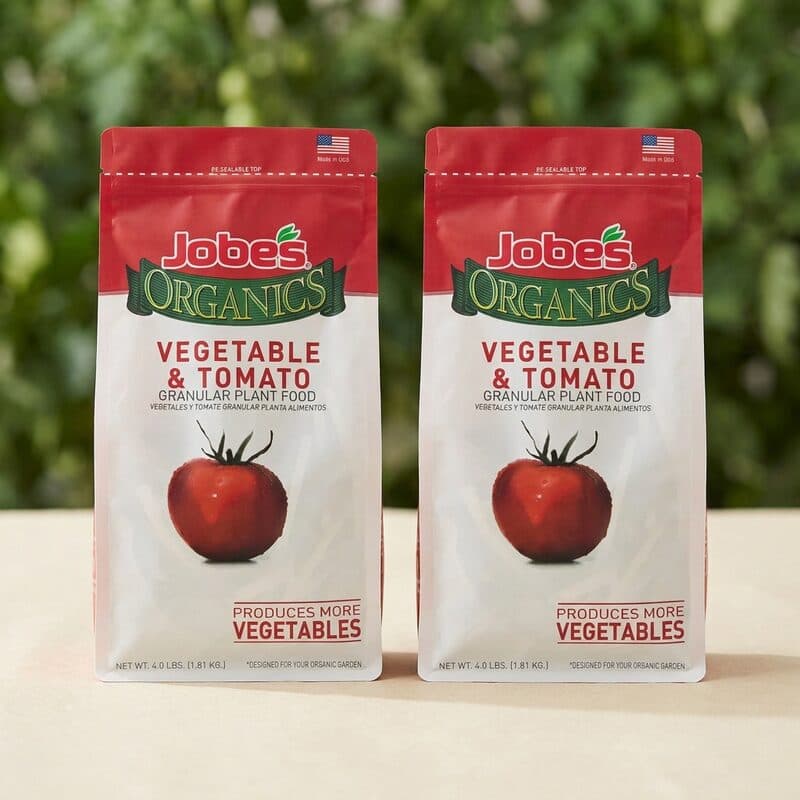
Jobe's Organics Vegetable & Tomato Granular Fertilizer
Best for: Budget-minded growers feeding tomatoes and vegetable beds organically.
Keep in mind: Strong odor that can attract animals
Amazon price as of the checked date, subject to change. The price on Amazon at checkout applies.
Full research
- NPK
- 2-5-3
- Type
- Granular organic
- Microbes
- Biozome beneficial microbe package
- Use
- Vegetables, tomatoes, and fruiting crops
An affordable certified-organic granular fertilizer formulated for vegetables and tomatoes, with a higher phosphorus ratio to support fruiting and the brand's Biozome microbe package.
This catalog-wide research score is separate from this guide's use-case ranking. How we research
Strengths
- Phosphorus-forward profile suits fruiting crops
- Very affordable certified-organic option
- Biozome microbes aid nutrient breakdown
Weaknesses
- Strong odor that can attract animals
- Best as a targeted feed rather than all-purpose
Sprout Score breakdown
Best for
Budget-minded growers feeding tomatoes and vegetable beds organically.
Owner rating snapshot
Amazon · 68 reviews · 4.6 stars
Avoid excess nitrogen late in the season; it pushes vegetative growth at the expense of fruit sugar development.
Pollination: bees are essential
Cantaloupe produces separate male and female flowers on the same vine. Male flowers typically appear first, a week or more before females. Female flowers are identified by a small immature fruit (ovary) at the base of the flower.
Bees transfer pollen from male to female flowers. Cantaloupe requires multiple pollinator visits for well-formed fruit; inadequate pollination produces misshapen, small, or hollow fruit. Poor pollination is a significant cause of yield loss in gardens with low bee activity.
To support pollination:
- Remove floating row cover when the first flowers open
- Avoid pesticide applications during flowering, especially morning hours
- Grow nectar-producing flowers nearby to attract pollinators
Row cover is useful early in the season to protect young transplants from striped cucumber beetle and spotted cucumber beetle, which spread bacterial wilt. But it must come off at flowering, without exception.
Protect young plants
Agribon AG-19 Floating Row Cover
Best for: Gardeners who want cheap frost protection and pest exclusion in one fabric.
Keep in mind: Lightweight fabric tears and wears over seasons
Amazon price as of the checked date, subject to change. The price on Amazon at checkout applies.
Full research
- Weight
- 0.55 oz per sq yd
- Frost protection
- Down to roughly 28F
- Light transmission
- About 85%
- Material
- Spun-bonded polypropylene
A lightweight spun-bonded row cover that drapes over crops to add a few degrees of frost protection while still letting in light and water. It doubles as a physical barrier against many insect pests.
This catalog-wide research score is separate from this guide's use-case ranking. How we research
Strengths
- Extends the growing season at both ends
- Excludes many pests without chemicals
- Passes most light and water so it can stay on
Weaknesses
- Lightweight fabric tears and wears over seasons
- Needs hoops or pins to stay put in wind
Sprout Score breakdown
Best for
Gardeners who want cheap frost protection and pest exclusion in one fabric.
Common problems
- Striped cucumber beetle and spotted cucumber beetle: vectors for bacterial wilt. Row cover on transplants, then kaolin clay or Spinosad once flowers open.
- Bacterial wilt: wilt starts in individual leaves and progresses to whole-vine collapse. No treatment; remove and destroy infected plants immediately to limit beetle movement.
- Powdery mildew: white powdery coating on leaves, most common late in the season. Improve air circulation and avoid overhead watering.
- Downy mildew: angular yellow patches on leaf surfaces. Favored by cool, wet weather and heavy dew.
- Anthracnose: dark, water-soaked lesions on fruit. Use crop rotation and disease-resistant varieties.
- Aphids: cluster on new growth; usually managed by beneficial insects but can transmit mosaic virus.
- Squash bug: large, gray-brown bugs and egg clusters on leaves. Hand pick egg masses and adults; nymphs are easier to control than adults.
Harvesting: reading cantaloupe ripeness
Unlike watermelon, ripe cantaloupe signals are easy and unmistakable once you know what to look for. Do not rely on days-to-maturity alone; the signals below are more accurate.
Cantaloupe ripeness signals
Smell
Slip
Netting
Color under the netting
Feel
Cantaloupe will not ripen further once picked, unlike some other fruit. Pick at full slip for best sweetness. Once harvested, store at room temperature for a day or two, then refrigerate.
How many cantaloupes does one plant produce?
Most cantaloupe plants yield 3 to 5 fruits per plant under good growing conditions. Yield depends on vine health, bee activity for pollination, and consistent moisture. Pinching off some fruit when plants are heavily set can improve the size and quality of the remaining fruit.
Why are my cantaloupe vines wilting even with good watering?
Sudden wilting that doesn't recover in the evening is a classic sign of bacterial wilt, spread by cucumber beetles. Do the wilt test: cut a wilted stem near the base, hold the two cut ends together for 10 seconds, then slowly pull them apart. If you see stringy threads (bacterial ooze) bridging the gap, bacterial wilt is the diagnosis. There is no treatment; remove and destroy the plant. See bacterial wilt for more detail.
Can I grow cantaloupe in a raised bed?
Yes. Compact varieties work well in a large raised bed with vines trained over the sides or up a sturdy trellis. Standard varieties are easier to manage when they can run over a broad mulched area. Raised beds also improve drainage in heavy soil.
What is the difference between cantaloupe and muskmelon?
In US usage the terms are often interchangeable. True cantaloupe (Cucumis melo var. cantalupensis) is more common in Europe and has a rough, segmented skin without netting. Most melons sold as "cantaloupe" in the US are actually muskmelons (Cucumis melo var. reticulatus), identifiable by their raised, corky netting. Both are grown the same way.
Do I need more than one cantaloupe plant for pollination?
No. Cantaloupe plants produce both male and female flowers on the same vine (monoecious). You only need one plant, but you do need bees or other pollinators to transfer pollen between flowers. A single plant in an area with poor bee activity will still struggle to set fruit well.
See also: how to grow watermelon, how to grow cucumbers, companion planting guide, extend growing season, cantaloupe plant profile.